Maee — a WooCommerce kids' clothing store in 5 days
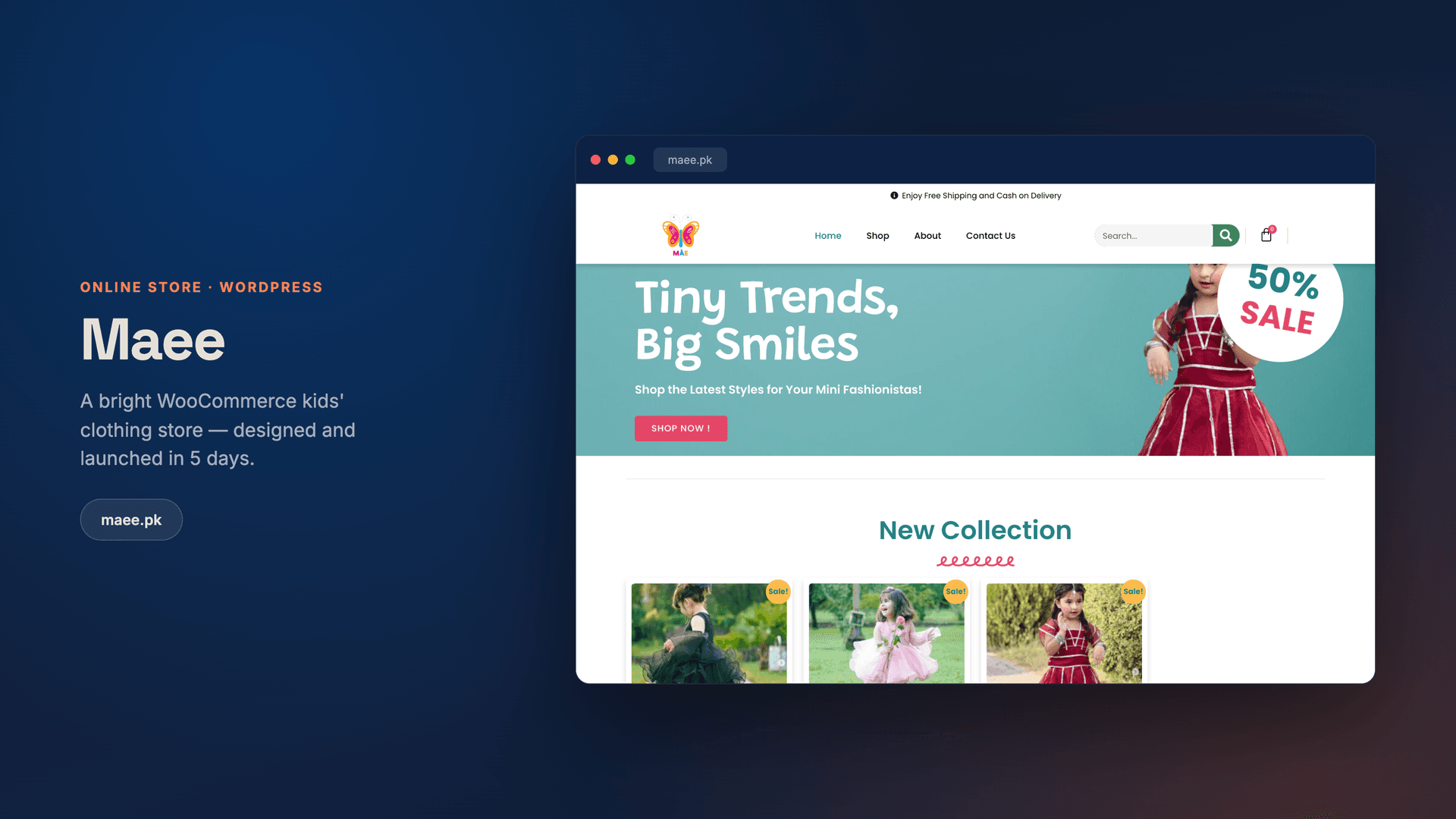
A bright, playful WordPress and WooCommerce store for Maee, a kids' clothing brand — shop-by-category across boys, girls, headdress and footwear, sale pricing, product pages and cash-on-delivery checkout. Designed and launched in five days. The store was handed over in full and the address we built it on no longer resolves; we do not host or maintain it, and we have not published a replacement link we cannot verify.
The brief
A kids' clothing brand had a season to catch and five days to be trading in it — so the structure had to be right first time and the merchandising had to be theirs to run.
Maee had a season to catch and five days to be trading in it. That is the ordinary shape of a small fashion launch in Pakistan and it is the constraint that decides everything else: a five-day build cannot be a bespoke platform, so the question is not what to construct but which decisions cannot be got wrong, because they are the ones nobody will have time to revisit.
Three of them mattered here. The first is how a parent shops. Nobody buying for a four-year-old browses a flat catalogue of SKUs — they arrive knowing the child, the occasion and roughly the size, and they want the store cut the same way. A grid of everything is a grid nobody finishes scrolling.
The second is payment. Cash on delivery is not a fallback in this market, it is the default, and a checkout that asks for a card first loses the majority of the people who reach it. That is not a checkout setting bolted on at the end; it changes the whole order flow — confirmation before dispatch, address quality, what a return costs the seller.
The third is who owns the store afterwards. A kids' clothing range turns over constantly: new stock, new sizes, a sale that has to start on Friday. If adding a product means finding the agency that built it, the store stops growing the week the engagement ends. A fast build that can only be maintained by its builder is not a fast build, it is a slow dependency.
The build
A WordPress and WooCommerce store, built so the fast decisions were the structural ones and the rest of it was merchandising the client could run themselves.
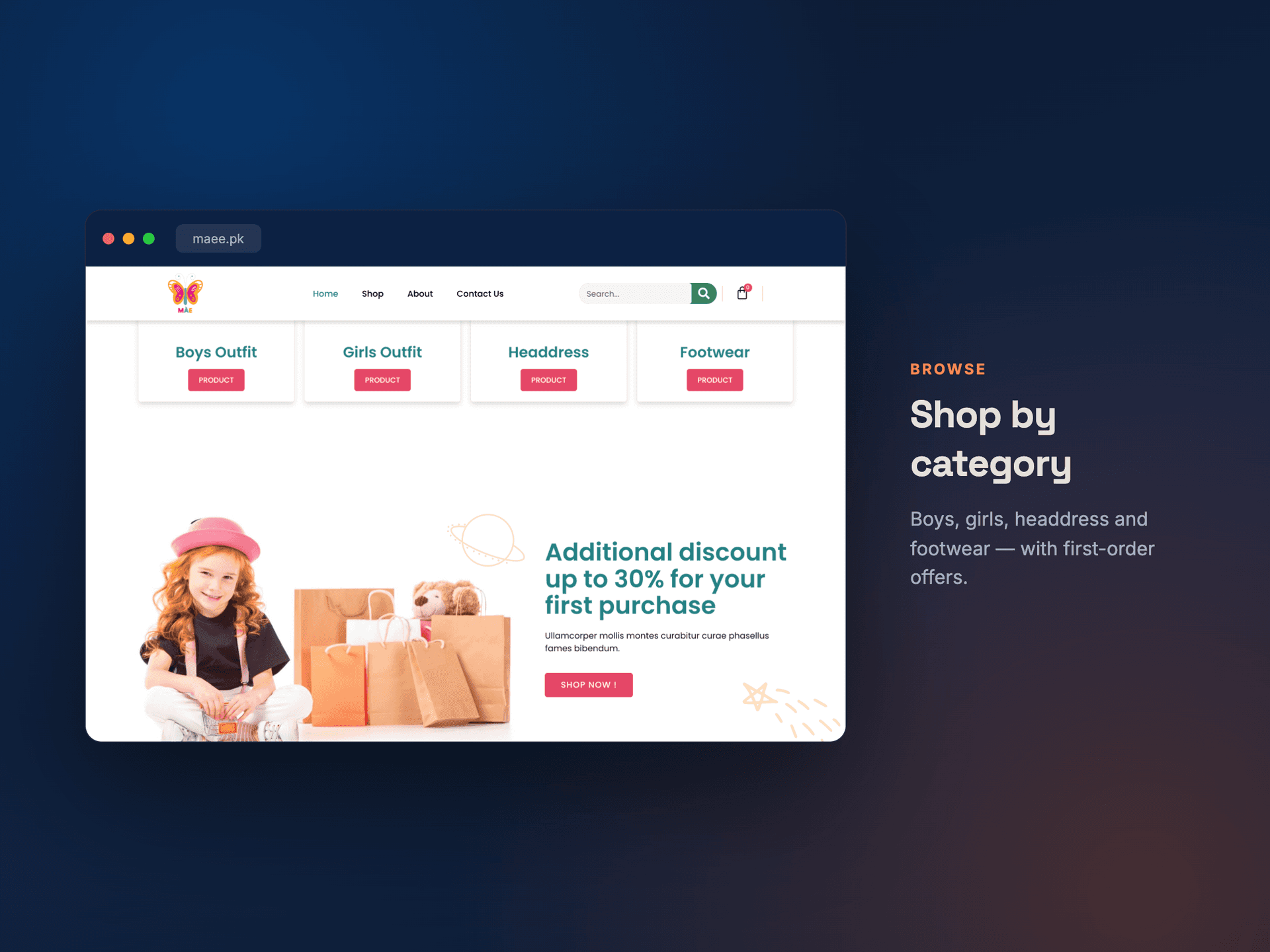
Categories carry the navigation rather than sitting underneath it. Boys Outfit, Girls Outfit, Headdress and Footwear are the entry points on the home page, in the order a parent actually narrows down, so the first click does most of the filtering and the catalogue behind them can grow without the front of the store needing to change. Products sit in WooCommerce's own category tree, which is what makes that true — the storefront reflects the catalogue rather than a hand-built menu that drifts out of date the first time somebody adds a line.
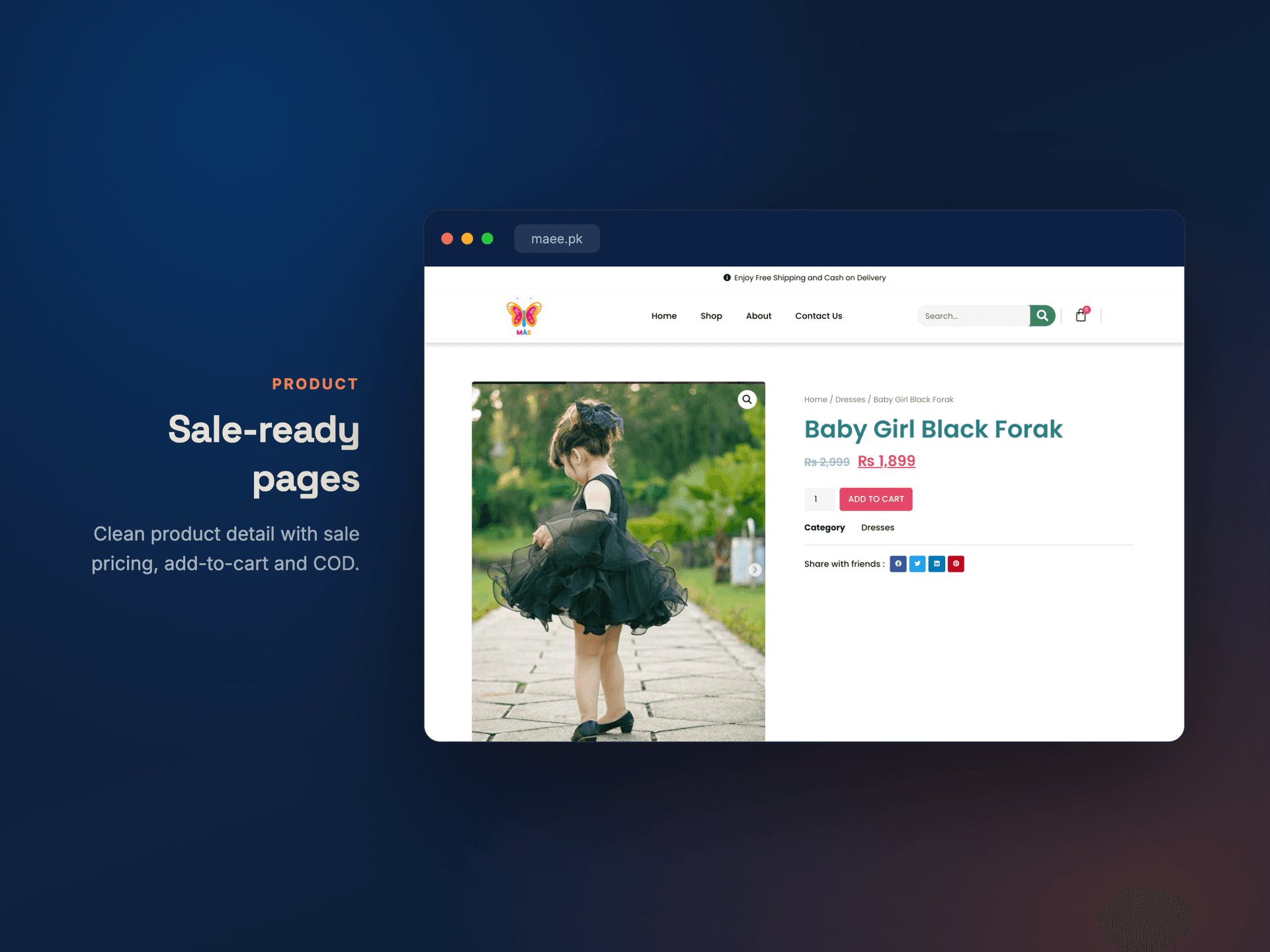
The merchandising runs on fields WooCommerce already has, not plugins. A sale price is the product's own second price, so the struck-through original, the Sale! flash on the tile and the price on the product page are one edit in one box — which is the difference between a sale the owner can start on a Friday afternoon and one that needs a developer. The same logic put the two things that decide a Pakistani purchase into the announcement bar above the nav, free shipping and cash on delivery, where they are read before anything is browsed rather than discovered at checkout.
Product pages were kept deliberately plain: breadcrumb, gallery, price, quantity, add to cart, category, share. On a mobile connection over a five-day build, every element that is not the decision is weight.
Design and setup went in on day one, categories and the catalogue across days two and three, the sale section and cash-on-delivery checkout on day four, mobile QA and launch on day five. Then it was handed over in full.
What happened next is not ours to report. We have not had access since handover, the address the store was built on no longer resolves, and the Internet Archive holds no copy of it — so there are no traffic, order or revenue figures in this study, and the screenshots above are the store as delivered, before the owner's own catalogue and copy went in. The five days are recorded. The rest would be invention.
Architecture
The catalogue is the navigation.
Four categories in the order a parent narrows down, sale pricing on WooCommerce's own fields, and the two things that decide a Pakistani purchase stated above the nav.
Build timeline
Five days.
Design + setup
Brand, layout and WooCommerce install.
Categories + catalogue
The four entry points and the products behind them.
Sale + checkout
Sale pricing, first-order offer, cash on delivery.
QA + handover
Mobile QA, launch, and the store handed over in full.
Recorded at handover · store no longer online
By the numbers.
Tech we used
A small stack.
More build work.
All case studies →

Trusted by teams like yours





The service behind this project
Need the same work?
WordPress Development in Pakistan
A WordPress development agency in Pakistan building fast, maintainable sites and WooCommerce stores — plugin budgets and hosting in your…
WordPress and WooCommerce for US Businesses
A WordPress development agency USA owners can stop paying: sites you edit yourself on a maintainable plugin list, hosting and licences in…
WordPress & WooCommerce Development for UK Businesses
A WordPress development agency UK owners stop needing: eleven published builds including a British WooCommerce store the client runs…