What actually costs American retailers money
Three problems that do not exist in most other markets.
The catalogue-and-checkout half of this job is the same everywhere. These three are not, and they are where American store projects quietly go over budget.
Sales tax is fifty problems wearing one name
Since economic nexus became the rule, selling into a state can create an obligation there without you ever setting foot in it, and the thresholds differ by state in both revenue and transaction count. The engineering answer is well-established — a tax engine wired into checkout, addresses validated so the rate is right at the line level, and returns handled so refunds reverse correctly. The part we will not do is tell you where you have nexus. That is your accountant's call, it has legal consequences, and an agency that answers it confidently in a sales call has not read the rules either. What ecommerce website development USA retailers should insist on is that the mechanism is built properly and the liability question is routed to someone qualified.
Shipping is priced by zone, and the store usually does not know
A flat national shipping rate is a decision to lose money on long-haul orders and overcharge on local ones, and most stores make it by accident because configuring real zones is fiddly. Rates that reflect actual carrier costs, free-shipping thresholds set where the margin genuinely supports them, and a delivery estimate the customer can believe — those are configuration rather than engineering, and getting them right usually moves more money than a redesign does.
Returns are designed in January, after the first December
Almost every store launches with a returns policy written as a paragraph and no mechanism behind it. Then the holiday volume arrives, and the support inbox becomes the returns system. A returns flow the customer can start themselves, that produces a label and updates the order, is unglamorous and it is the difference between a January that is busy and one that is a crisis.
Delivered — with the country attached
Two American stores, and the wider set.



Choosing the platform, and the two American stores
The platform argument gets far more attention than it deserves and is usually settled by one or two facts about your business. Here is the honest version, then the American work.
The platform decision in four sentences
Shopify for most retailers, because hosting, PCI scope and checkout security stop being your problem and that is worth more than merchants expect. WooCommerce when your product or pricing logic is genuinely unusual, when you are already committed to WordPress, or when paying a platform a share of revenue forever is unacceptable. Bespoke only when the thing you sell does not fit a catalogue at all — subscriptions with complex proration, rentals, anything where the order is a process rather than a purchase. If an agency recommends the same platform to everyone, they are describing their staffing rather than your business.
The store you can open right now
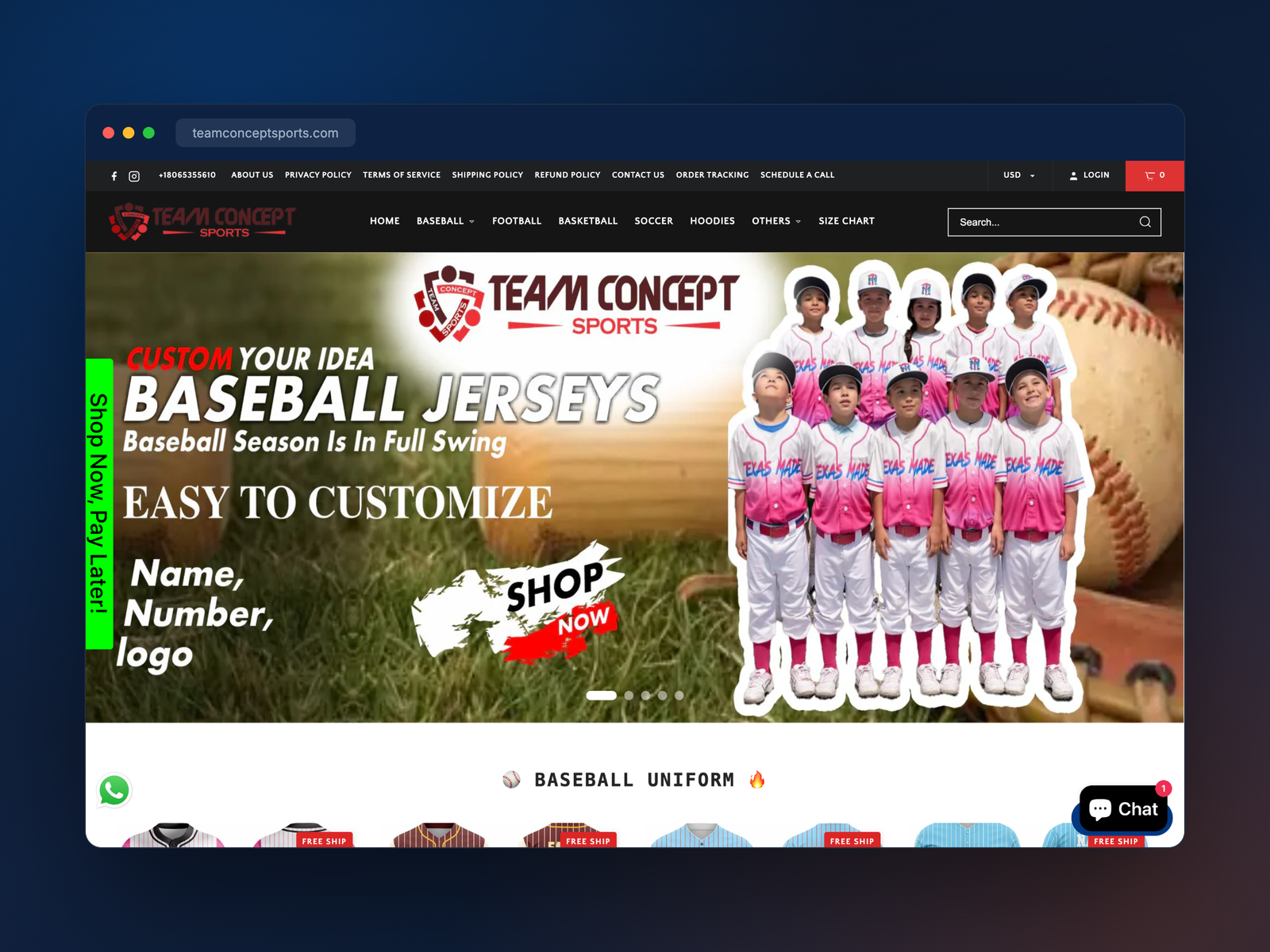
teamconceptsports.com sells made-to-order team kit and we took it from design to launch in three weeks. Read on 12 September 2026 it carries 675 products and 10,784 variants across 45 collections, ten catalogue-wide and thirty-five cut by state across Texas, Oklahoma, Colorado, Louisiana and New Mexico. Configuration is modelled as Shopify variants rather than bolted on with an app, which is why a catalogue that size is still navigable and why the client has been growing it themselves ever since without a developer on call.
The store that is gone
rockybestbuds.com was a WooCommerce store priced by weight band. As of 12 September 2026 the domain serves a parking page rather than the store. We handed over the site, its hosting and every credential at launch, which is why we cannot restore it and why we are telling you rather than leaving it in the list to be clicked. An ecommerce growth agency USA merchants can trust is one whose portfolio has verifiable gaps in it rather than one where everything conveniently still works.
Related, and deliberately separate
The neighbouring problems have their own pages.
Shopify specifically
Variant modelling, app reduction and the made-to-order catalogue at scale — where the American proof lives.
Traffic that will not convert
Checkout, product pages and the arithmetic of testing honestly when your volume is too low for significance.
Moving off your current platform
Replatforming without losing URLs, order history or the search visibility you have already paid for.
Getting people to the store
Search and paid, run against cost per acquisition — with our published-proof position stated plainly.
How it runs
You see the price at step two.
Store teardown
Free, written, inside 48 hours. Catalogue structure, checkout, shipping configuration, app costs and what is leaking money.
Scope and fixed price
Templates, the product model, tax and shipping configuration, and the returns flow — written down before anyone starts.
Build overnight
A development store from week one. You review at the end of your day; the next version is there in the morning.
Launch and hand over
Store, domain, payment and every app account in your name. Changing agency later costs you nothing but the notice.
Money
How we quote store work.
Fixed-scope build
A new store or a rebuild, on whichever platform the teardown concluded was right. One written scope, one price in dollars, inside 48 hours of the call.
- ✓Free teardown first
- ✓Tax and shipping configuration included
- ✓Out-of-scope stated explicitly
Catalogue and checkout work
For retailers whose store works but whose products, shipping zones or returns are costing them. Usually the highest-return work available.
- ✓Variant model rebuilt
- ✓Zones priced against real costs
- ✓Redirects mapped before launch
Ongoing store work
Monthly, for retailers shipping changes continuously. Scoped after a teardown, cancellable with notice, reported against what actually shipped.
- ✓Cancel with notice
- ✓Named queue, agreed monthly
- ✓Nothing bundled you did not ask for
There is no rate card on this site, in any currency, deliberately. What is fixed is the process: free teardown, written scope, one price, agreed before anyone starts.
FAQ
Straight answers.
Built and run by us
Our own products, in production.
More from GOFTECH
Where to look next.
Ecommerce Development for UK Retailers
An ecommerce development agency UK retailers can outgrow us with: 14 published stores across four platforms, including a British…
WordPress and WooCommerce for US Businesses
A WordPress development agency USA owners can stop paying: sites you edit yourself on a maintainable plugin list, hosting and licences in…
Shopify Development for US Merchants
A Shopify development agency USA merchants can verify: an American made-to-order store carrying 675 products and 10,784 variants, launched…