RapidKill — an internal company app for a pest-control firm
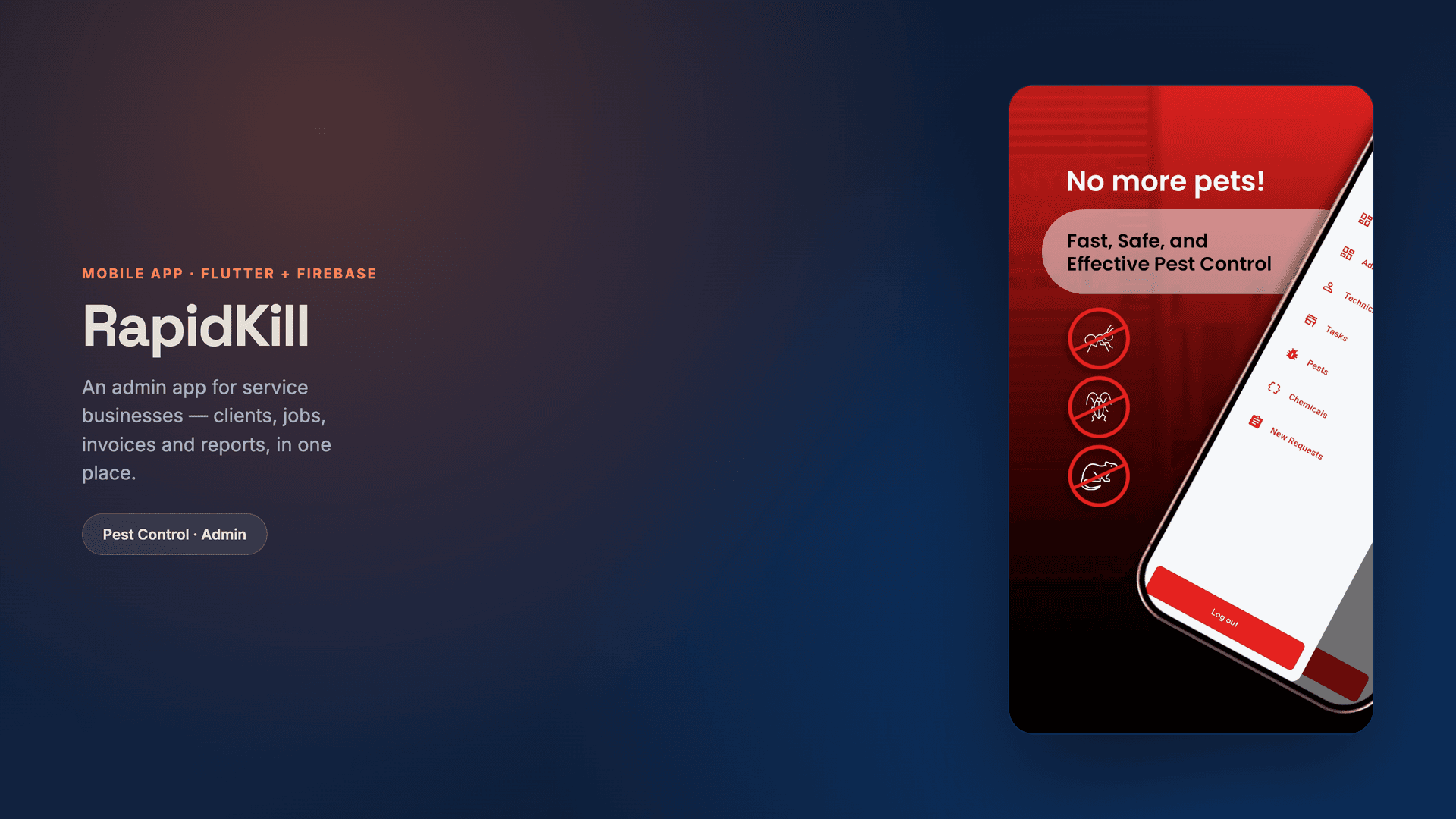
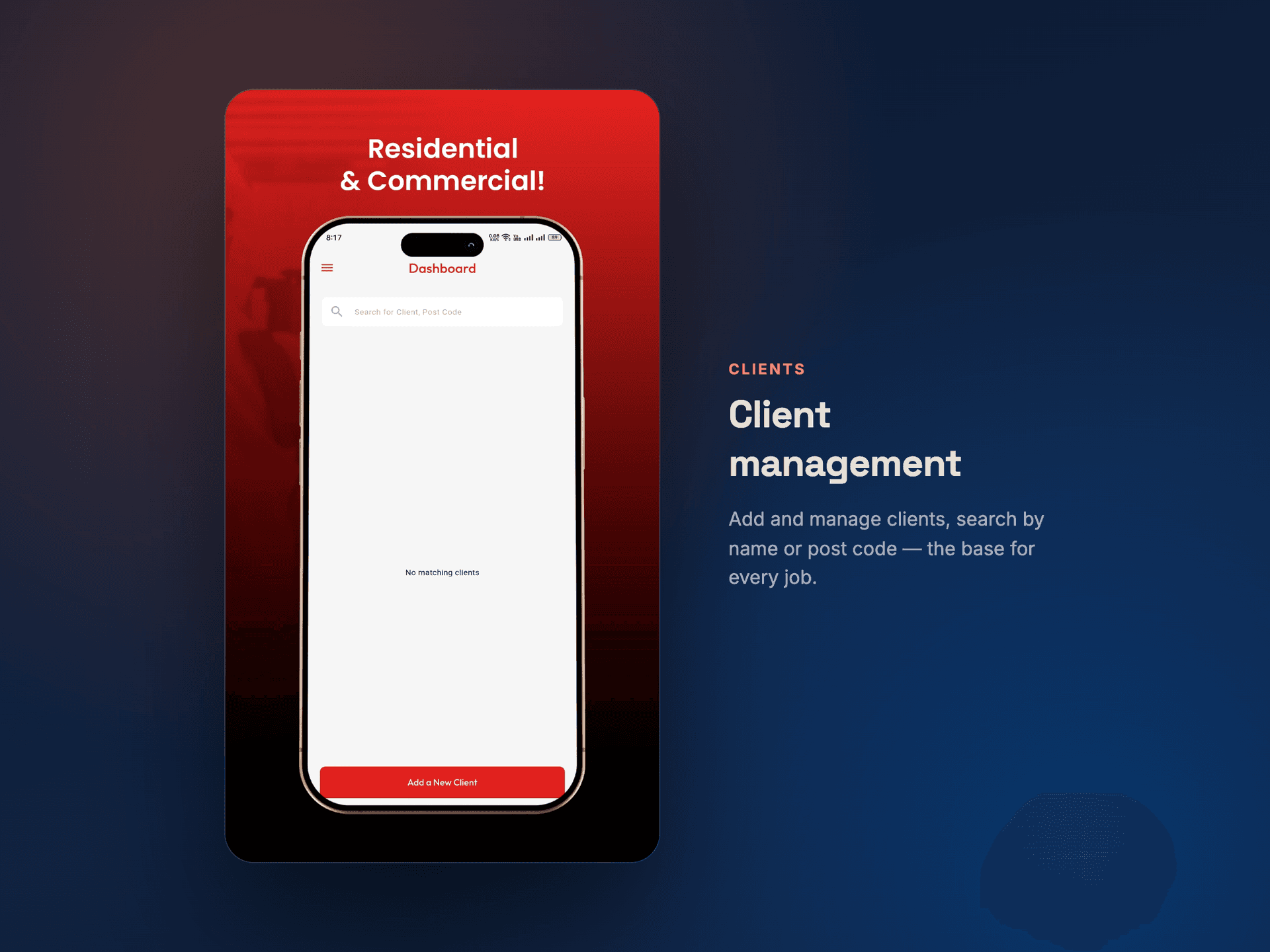
We built RapidKill's internal company app in six weeks — a Flutter and Firebase app the pest-control firm's own office and field team use to manage clients, schedule and report on jobs, raise invoices, and email or print client-ready PDFs, with role-based access across the team.
The brief
Clients, jobs, invoices and reports — scattered across paper and spreadsheets. One admin app to run it all.
A pest-control business runs on four things: who the client is, what job is booked, what was found and treated, and whether the invoice went out. In most firms of this size those four things live in four places — a phone's contacts, a paper diary, a technician's notebook and a spreadsheet somebody rebuilds every quarter — and the gaps between them are where the money leaks.
The specific failure is the report. Field service is one of the few trades where the deliverable is a document: a client wants to see what was inspected, what was found and what was done, and for a commercial client that record is often a compliance requirement rather than a courtesy. When that document is assembled by hand from a notebook after the fact, it goes out late, it goes out inconsistent, or it does not go out at all — and the invoice usually waits behind it.
RapidKill wanted one internal app that closed the loop for its own team — not an off-the-shelf field-service subscription bent to fit, but a tool shaped around how their office and technicians already work. With owners, office staff and technicians all in the same system, roles and permissions had to be there from day one, not bolted on later.
The build
A Flutter app on a Firebase backend, built in six weeks. Clients, jobs, invoices and reports are one connected record rather than four disconnected ones: a job belongs to a client, a report belongs to a job, an invoice references both, and nothing has to be retyped from one into another.
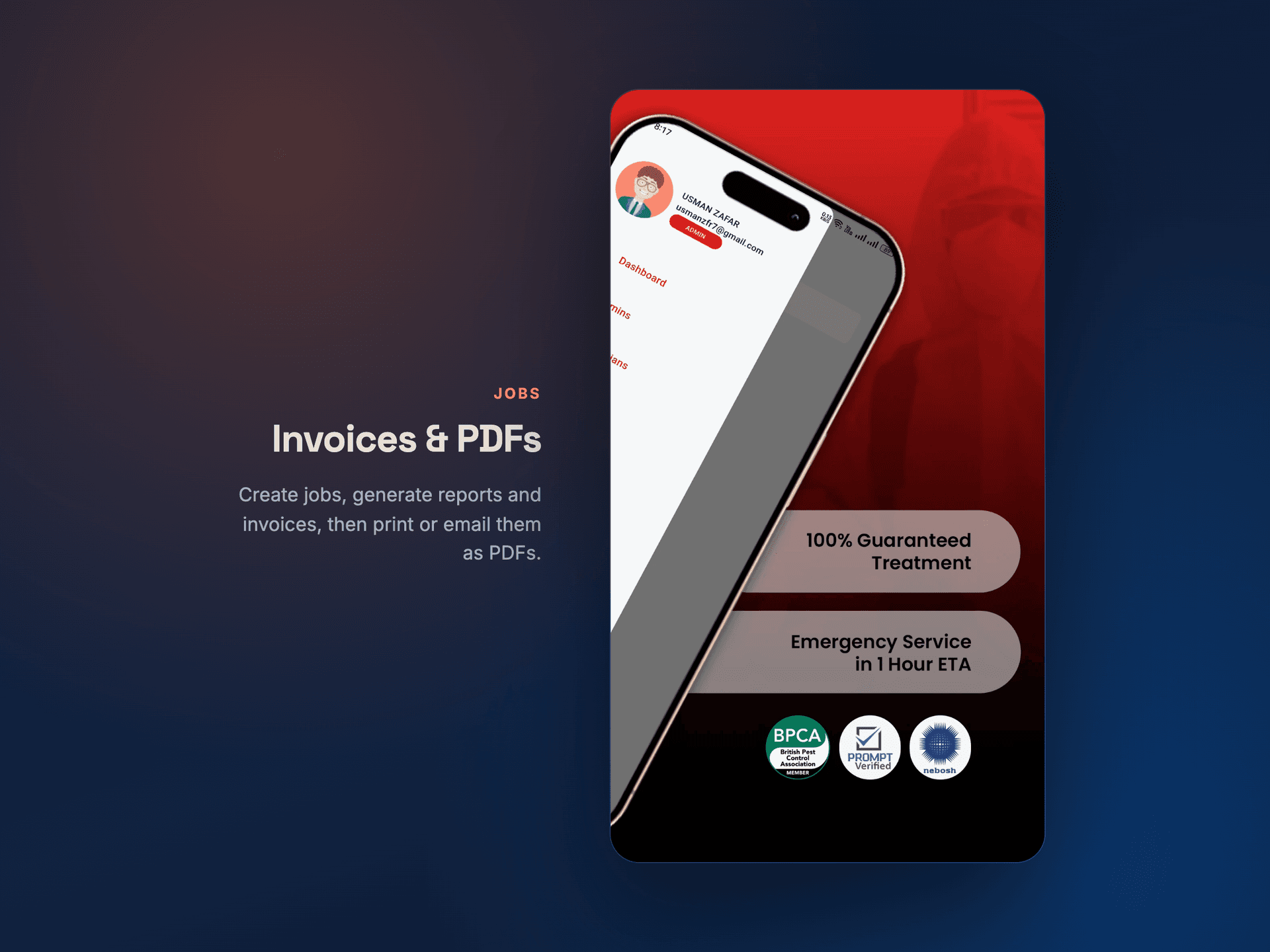
The report and invoice generator produces a client-ready PDF that can be emailed or printed straight from the app, which is the feature that actually changes the working day — the document leaves while the technician is still on site, instead of joining a pile for the weekend. In-app reminders carry the scheduling load, and role-based access means an owner, an office administrator and a field technician each see the part of the system that is theirs.
Firebase was the right call for a build on this schedule and a deliberate trade worth naming: it hands you authentication, a synced datastore and offline behaviour on day one rather than week four, and the price is a platform you do not own. For a six-week build of an internal tool that is a good trade. For a consumer product at scale it often is not, and we say which one you are building before we pick.
Six weeks, blank repository to a working app in users' hands on the date agreed.
Architecture
One admin app, end to end.
A Flutter front end, a Firebase backend, and built-in PDF generation, printing and emailing.
Build timeline
Six weeks. Four sprints.
Design + clients
Client-management module and the core data model.
Jobs + reports
Job creation, scheduling and job reports.
Invoices + PDFs
Invoice generation with PDF print and email.
Roles + launch
Role-based access, reminders, QA and store launch.
Results · since launch
By the numbers.
Tech we used
A small stack.
More build work.
All case studies →

Trusted by teams like yours





The service behind this project
Need the same work?
Mobile App Development in Pakistan
A mobile app development company in Pakistan shipping Flutter apps to both stores under your own developer accounts. Fixed price, full…
App Development in Islamabad
An app development company in Islamabad shipping Flutter apps to both stores under your own developer accounts. Four apps live, paperwork…
Mobile App Development for UK Businesses
A mobile app development company UK founders can get a real date from. Two British apps shipped, taken through store review, accounts in…