FleaMail
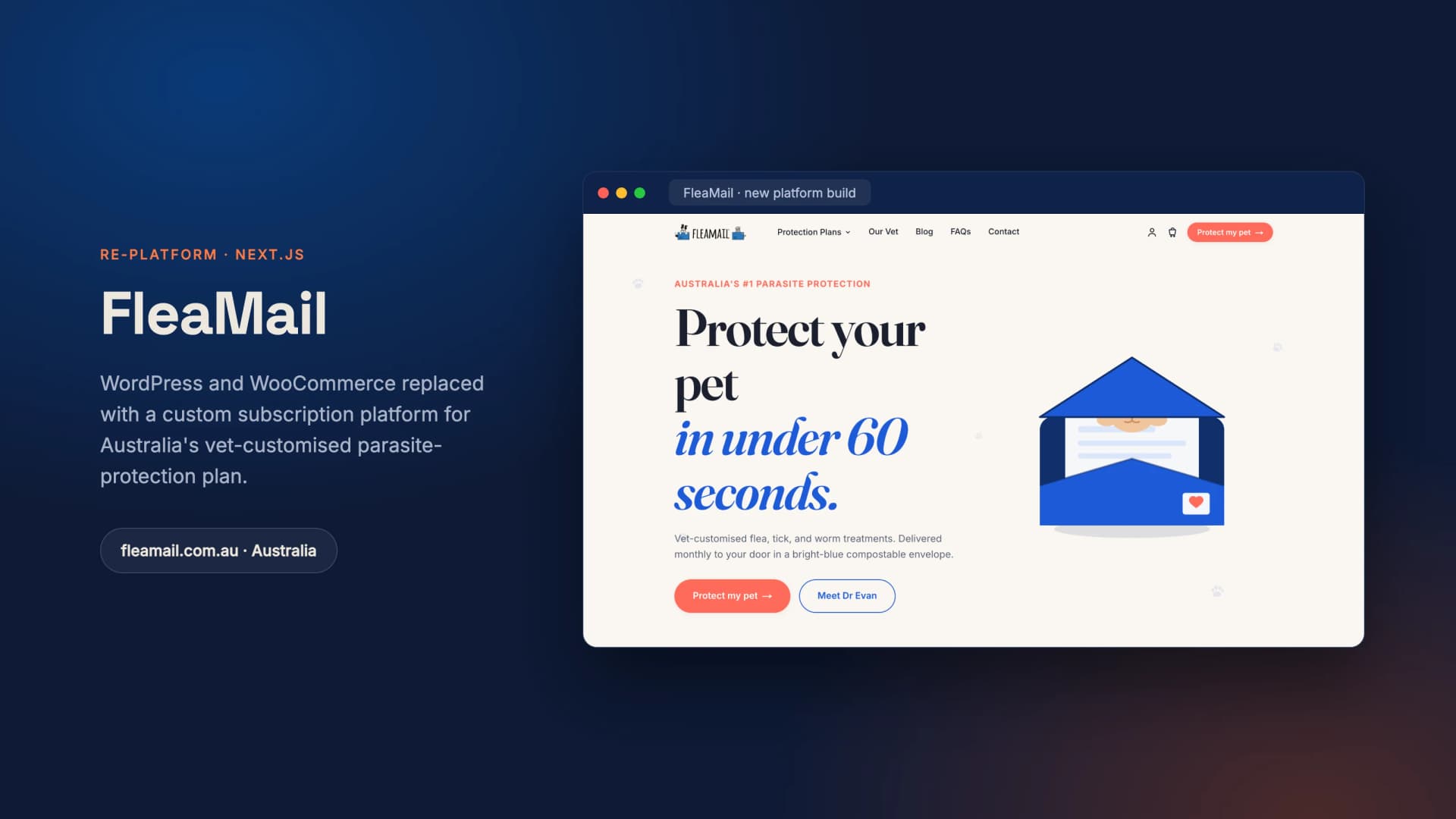
FleaMail posts vet-customised flea, tick and worm treatment to Australian pet owners every month, and ran the whole subscription business on WordPress, WooCommerce and a stack of plugins. We rebuilt it as one custom platform — Next.js, TypeScript and MySQL — with every customer, pet, subscription and order migrated and reconciled to the cent against the old system before anything is switched over.
The brief
Replace WordPress, WooCommerce and a stack of plugins with one platform — without losing a record, a renewal or a ranking.
A subscription business is only as good as its renewals, and FleaMail's ran through WooCommerce Subscriptions, two payment gateways, a treatment-code system built out of custom fields, and enough plugins that nobody could say with confidence what any one of them did. Every piece worked. Together they were slow, hard to change, and impossible to reason about — and the thing a re-platform most often breaks is the one thing this business cannot afford to break: the monthly charge that turns a customer into a customer next month.
The constraints were stated before any code was written, and they were absolute. Zero data loss: every customer, pet, subscription, order, line item, address and refund had to come across. Zero billing disruption: existing customers could not be asked to re-enter a card, and nobody could be charged twice or not at all. Zero SEO regression: years of articles about ticks, fleas and cane toads rank in Australian search and bring in most of the new customers, and a re-platform is the classic way to lose that overnight.
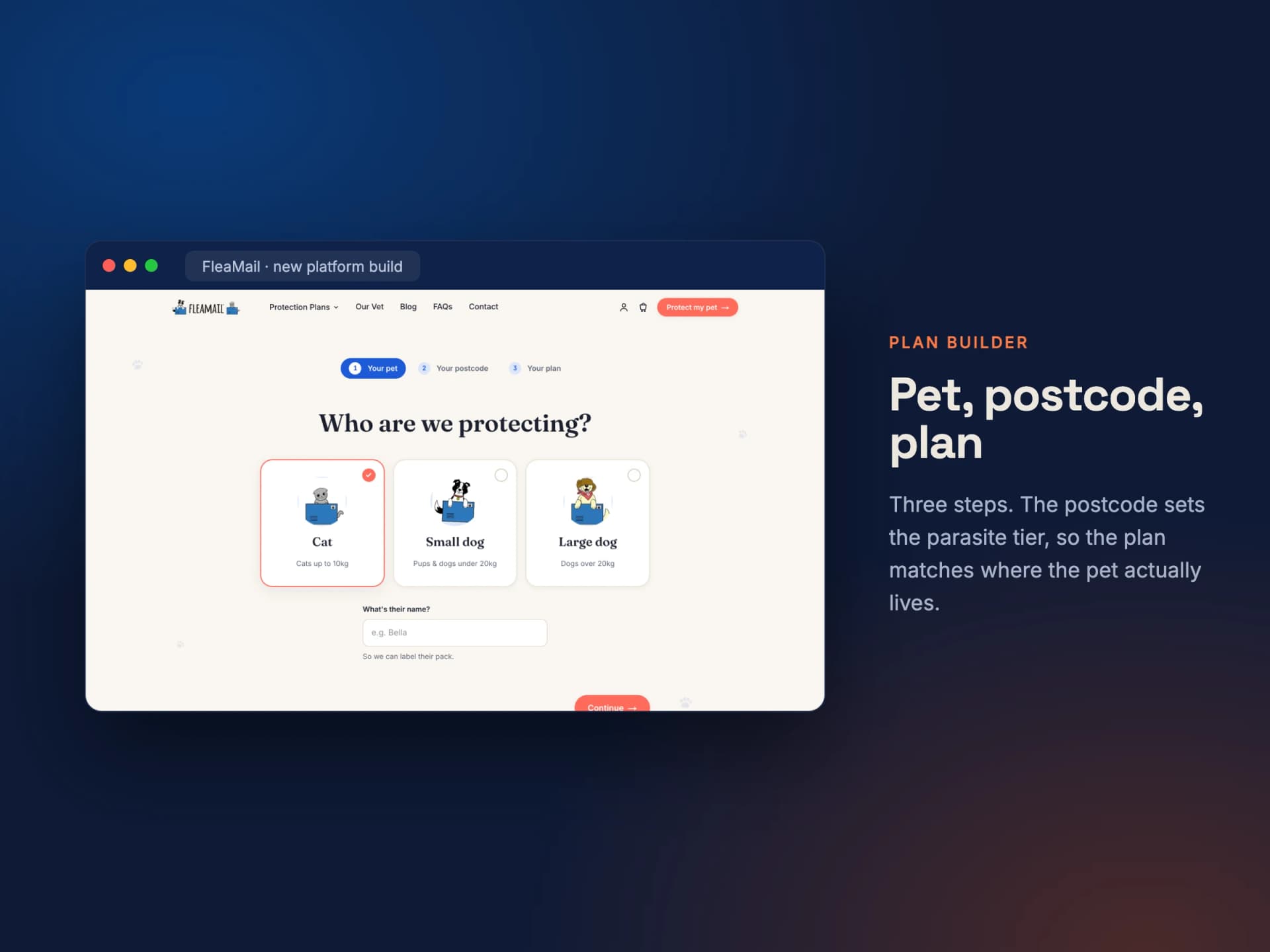
Then there is the product itself, which is more specific than it looks. The right treatment depends on the species, the weight and where in Australia the pet lives — paralysis tick country is not the same as Hobart — so the plan a customer is sold is decided by a postcode and a lookup table, and the pack that goes in the envelope by a treatment code the business has refined for years. None of that could be approximated.
The build
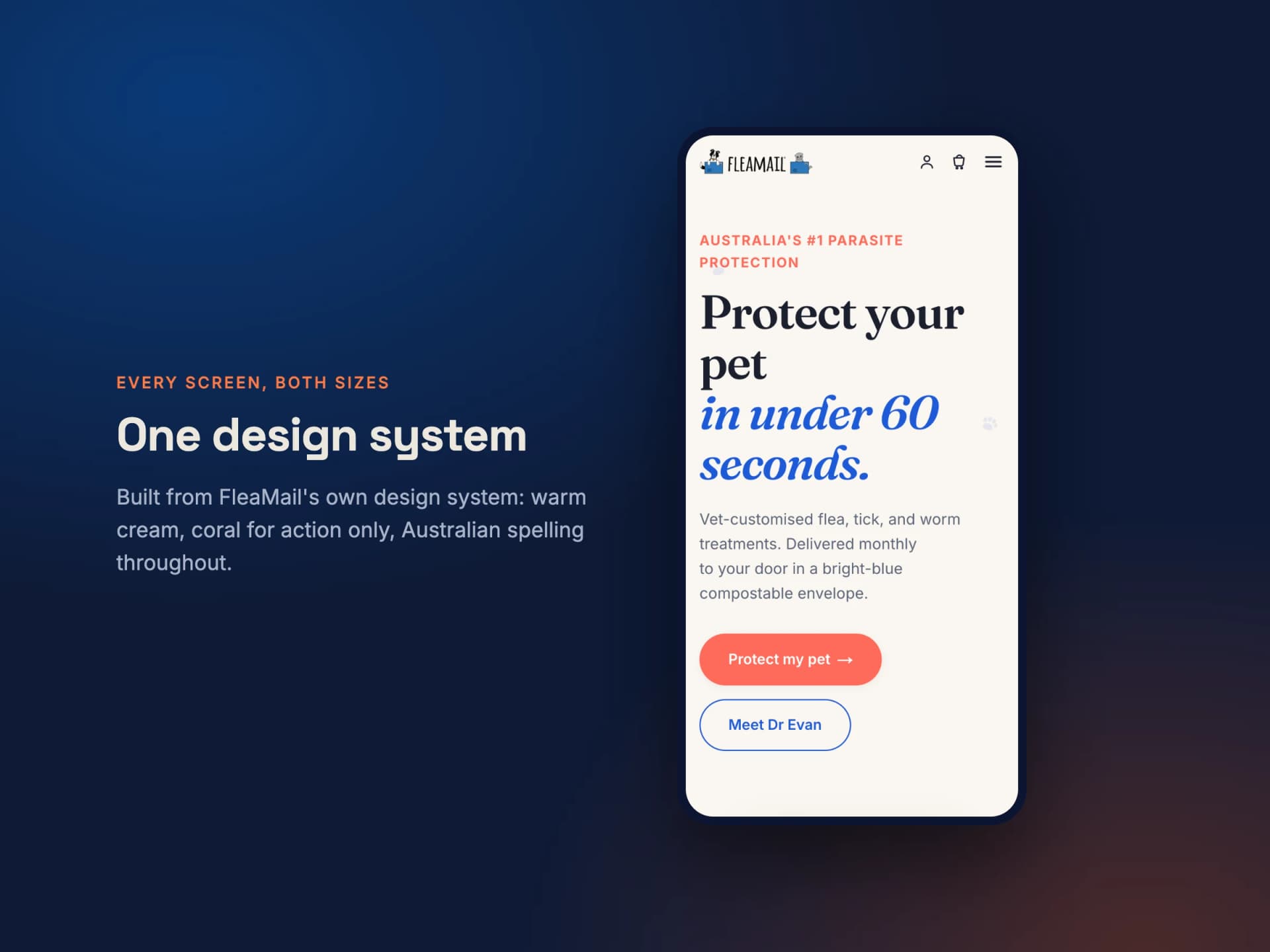
We built the replacement as a single Next.js 16 application on TypeScript, Prisma and MySQL: 55 data models, the public site, a customer account area, checkout, a 50-screen admin and a versioned API for a new Flutter mobile app. It was built from FleaMail's own design system — warm cream, coral for action only, Australian spelling throughout — rather than a template.
The data came across from a read-only mirror of the production WordPress database, through idempotent migration scripts that can be re-run at any time without creating duplicates. A reconciliation gate compares the two systems and exits with an error on any mismatch in counts or monthly recurring revenue; it is the thing that decides whether cutover can happen, not a person's confidence. It earned its place early: the first pass imported order headers without their line items, addresses and refunds, and the original gate only checked header counts, so it passed. We tightened the gate to check every relationship, backfilled the missing records, and it now reconciles green to the cent.
Billing continuity is structural rather than hopeful. The new platform uses the same Stripe and PayPal merchant accounts, so every stored customer and subscription reference carries over and nobody re-enters a card. Customers log in with their existing WordPress password, which is verified against the old hash and upgraded to bcrypt on first login. Webhook handling is idempotent, so a payment event delivered twice is processed once. And the whole platform runs in a shadow mode first: it receives the same payment events as the live site and applies them, but sends no email and charges nobody, while a nightly drift report compares it to WordPress subscription by subscription.
The treatment logic was carried across verbatim. The feline, canine and worming lookup tables are seeded from the business's own data and editable in the admin; the code is a pure lookup, and where a record has no code the platform shows none rather than generating one. Postcode decides the parasite tier, weight and species decide the product.
For search, we audited every URL that had earned traffic in the previous twelve months — 227 of them — and found that 118 would have returned a 404 on the new platform, almost all old WooCommerce product pages and WordPress archives. Each now has a 301 to its closest live equivalent, managed from a redirect table in the admin rather than hard-coded, alongside the migrated Yoast titles and descriptions, the 92 blog posts, structured data on every article and plan, and a 404 monitor for the weeks after launch.
The new platform is built and reconciling. Cutover follows the written runbook: a parallel run of at least four weeks with a clean drift report, a freeze on the old checkout, a final sync, the reconciliation gate, and only then the payment webhooks and DNS — with WordPress kept read-only for ninety days as a fallback.
Architecture
One application where there were a dozen plugins.
Public site, account area, checkout, admin and a mobile API share one codebase and one database — so a subscription means the same thing everywhere it appears.
Build timeline
Built in the order the risk demanded.
Data first
Read-only mirror, migration scripts and the reconciliation gate — before any screen.
Commerce core
Checkout, subscriptions, renewals, treatment codes, WordPress password carry-over.
Admin + CMS
Customer, subscription and fulfilment management; blog, pages, redirects.
App + marketing
Mobile API for Flutter; GA4 and Meta purchase events sent server-side; Merchant feed.
Shadow run → cutover
Parallel run with a nightly drift report, then the runbook.
Read from the codebase · 27 Sep 2026
By the numbers.
Tech we used
A small stack.
More build work.
All case studies →
Trusted by teams like yours




The service behind this project
Need the same work?
SEO for Australian Businesses
An SEO agency Australia businesses can check: 227 ranking URLs mapped for FleaMail's re-platform, reporting from your own Search Console…
Custom Software Development for UK Operators
Custom software development UK operators can maintain after we leave: booking platforms, CRMs and portals. Two live British platforms, full…
Web Development for Karachi
A web development company for Karachi trading, distribution and logistics businesses, run from an Islamabad studio. No fabricated local…