
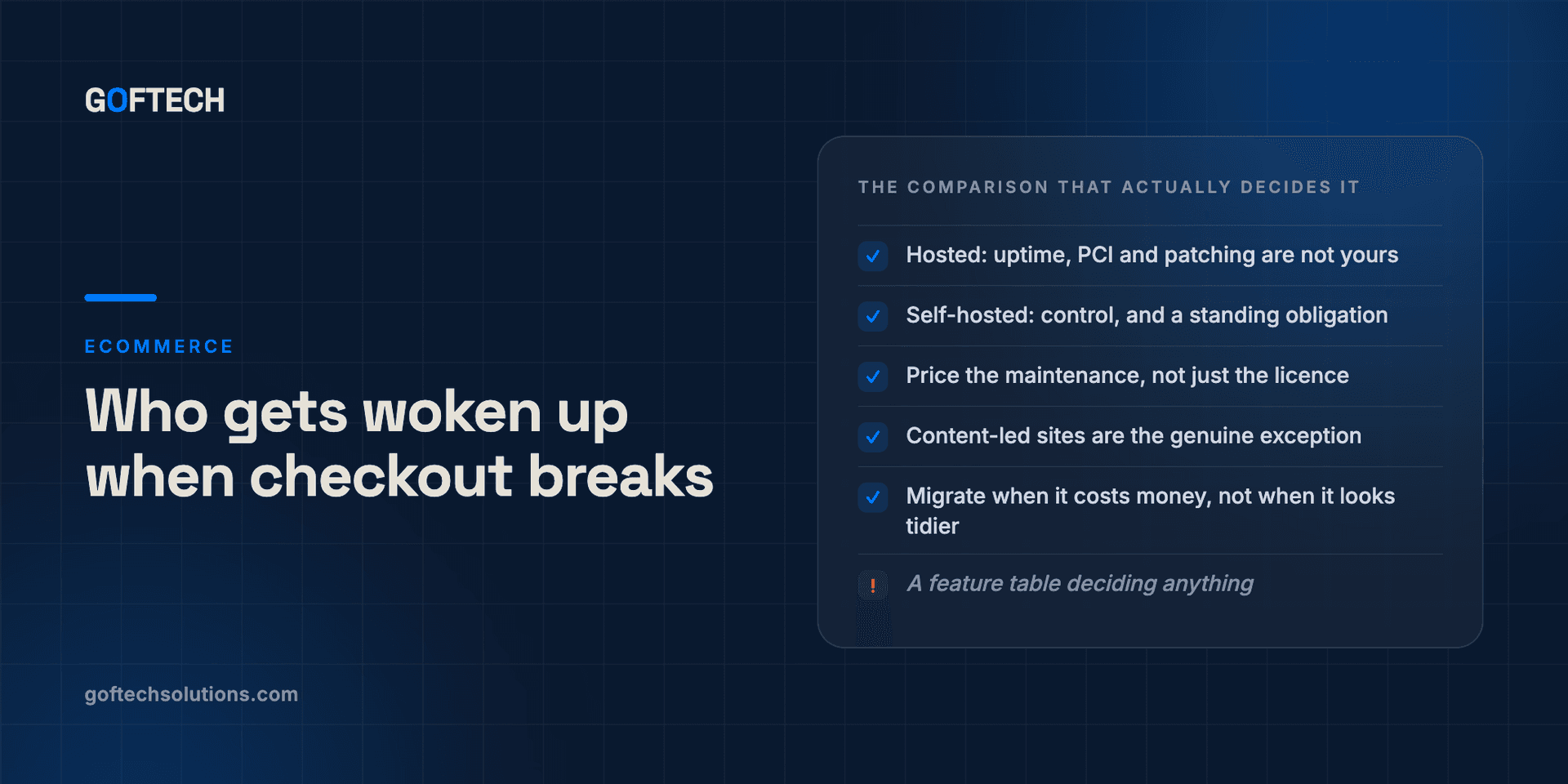
Most versions of this comparison are feature tables, and feature tables are the least useful way to decide. Both platforms sell products, take payments, handle variants, do discounts and integrate with the same shipping and accounting tools. At the level most brands operate, the features are close enough that they almost never decide anything.
What decides it is a question the tables never ask: when something breaks during your biggest sale of the year, whose problem is it?
The real difference is who carries the operational burden
On the hosted platform, a large set of problems is structurally not yours. Uptime under a traffic spike, PCI scope on the checkout, the security patch released this morning, the certificate that expires next month, the database that needs tuning — all of it sits with the vendor. You cannot fix those things and you also cannot forget to.
On the self-hosted platform, every one of those is yours, which is the price of the control that makes it appealing. That control is real and for some brands it is worth having. But it is a standing obligation rather than a one-off decision, and the failure mode is specific: nothing goes wrong for eleven months, everyone stops thinking about it, and the twelfth month is a plugin vulnerability being actively exploited across the internet while your checkout is down.
So the honest framing is not "which is better" but "do you want to own this category of problem". A brand with an in-house developer, or a retainer with someone who genuinely does the maintenance every month, can own it comfortably. A brand where the founder is also the person who would be woken up cannot, and should stop reading comparisons and pick the hosted one.
Where the money actually goes
There is no figure in this article — we have no verified pricing data to publish and an invented range would be worse than nothing. What we can do is tell you which lines to go and price for yourself, because the ones people forget are the ones that decide the outcome.
For the hosted platform, price the subscription, the transaction fees if you are not using the native payment processor, and the apps. Apps are the line that surprises people: a store can accumulate a dozen small monthly fees for functionality that feels essential and often is not. Add them up annually before you are shocked by them.
For the self-hosted platform, the licence is free and that is where the accounting usually stops, which is the mistake. Price managed hosting that can survive your peak rather than your average, the premium plugins that make it commercially viable, and — the big one — a maintenance arrangement. If you cannot name who does the updates and what they are paid, you have not priced the platform, you have priced the software.
Run both lists honestly and they land closer together than the licence fees suggest. The difference is rarely large enough to be the deciding factor, which is why we would rather you decided on the paragraph above this one.
Three situations where the answer flips
Content is the business and the shop is secondary. A publication, a course, a community that also sells a few things is a genuinely better fit for the self-hosted platform, because the content tooling is more mature and the shop is not carrying the operation. Do not move a working content site onto a commerce platform for the sake of consistency.
The product model is unusual. Configurable products with interdependent options, rental periods, complex bundles priced by rule, or B2B pricing that varies by customer are all places where the hosted platform's structure can fight you. It is worth prototyping the hardest product in your catalogue before committing — not the easiest one, which will work anywhere.
You are already on one and it is working. The cost of moving is almost always underestimated, and "working" is worth more than "better". Migrate when the current platform is actively costing you money, not when a comparison article makes the other one sound tidier.
What migration actually costs you, if you do move
The build is the visible part and rarely the risky part. The risk is in the URLs. A store that has been live for years has accumulated product pages, collection pages, blog posts and a long tail of tag, filter and pagination URLs that nobody remembers creating and that quietly earn traffic. Every one of them needs a destination on the new store before anything is switched over.
Get that right and a migration is invisible in your search traffic. Get it wrong and you lose rankings that took years to build, which is a far larger number than anything on the platform comparison. We have written up how the redirect map gets built and tested separately, because it is the part of the job that deserves more attention than it usually gets.
How we would actually advise you
If selling is the business and you do not have someone whose job includes the maintenance, take the hosted platform and spend the attention you save on the product and the advertising. That is the recommendation in the large majority of cases and we make it even when the other answer would be a bigger project for us.
If you have the technical capacity in-house, or your product model is genuinely awkward, or the shop hangs off a content operation that already works, the self-hosted platform is a legitimate choice and we build on it too. What is not legitimate is choosing it for the licence fee and then not budgeting for the maintenance, which is how most of the rescue work we get asked to do begins.
Either way, the thing worth doing first is listing your ten highest-traffic URLs and your three most awkward products. Those two lists answer this question faster than any comparison, this one included. If you would like a second opinion on what they say, we will read them and write back without a pitch attached.


