Where Australian stores lose money
Most of it happens after the first sale.
A store that converts once is a campaign. A store that renews, reorders and survives a platform change is a business, and that is where the build decisions actually matter.
The checkout does not look Australian
Prices must be shown including GST, not with tax added at the last step. Buy-now-pay-later is expected in plenty of categories. Delivery estimates have to account for the difference between metro Melbourne, Perth and a regional postcode. A checkout built for another market gets each of these slightly wrong, and shoppers notice every one.
Subscriptions are bolted on
Recurring billing added to a store through a plugin works until you need to change something — pause a plan, swap a product mid-cycle, discount the second pet, retry a failed card. FleaMail's new platform treats a subscription as the core object rather than an add-on, so pausing, tier changes, rescheduling and dunning are features of the system, not a fight with it.
The platform is a trap
Many stores reach the point where moving off their platform feels riskier than staying on it, and that is a strategic problem as much as a technical one. Any ecommerce agency Australia retailers consider should be able to describe exactly how it would get you out again — data, billing references, URLs — before it gets you in.
Australian stores
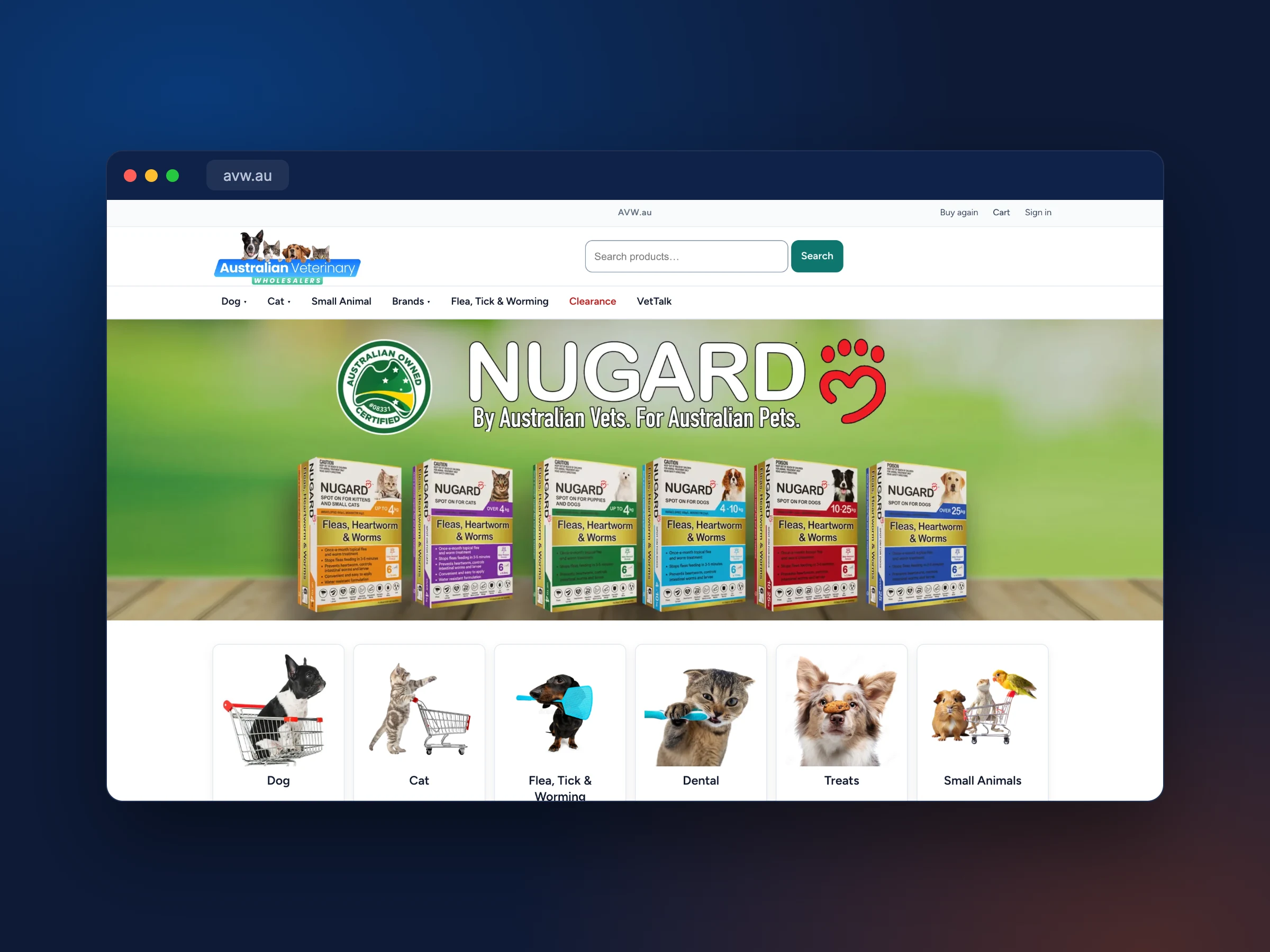
One rebuilt, and one we grow in search.
What building a store for Australians involves
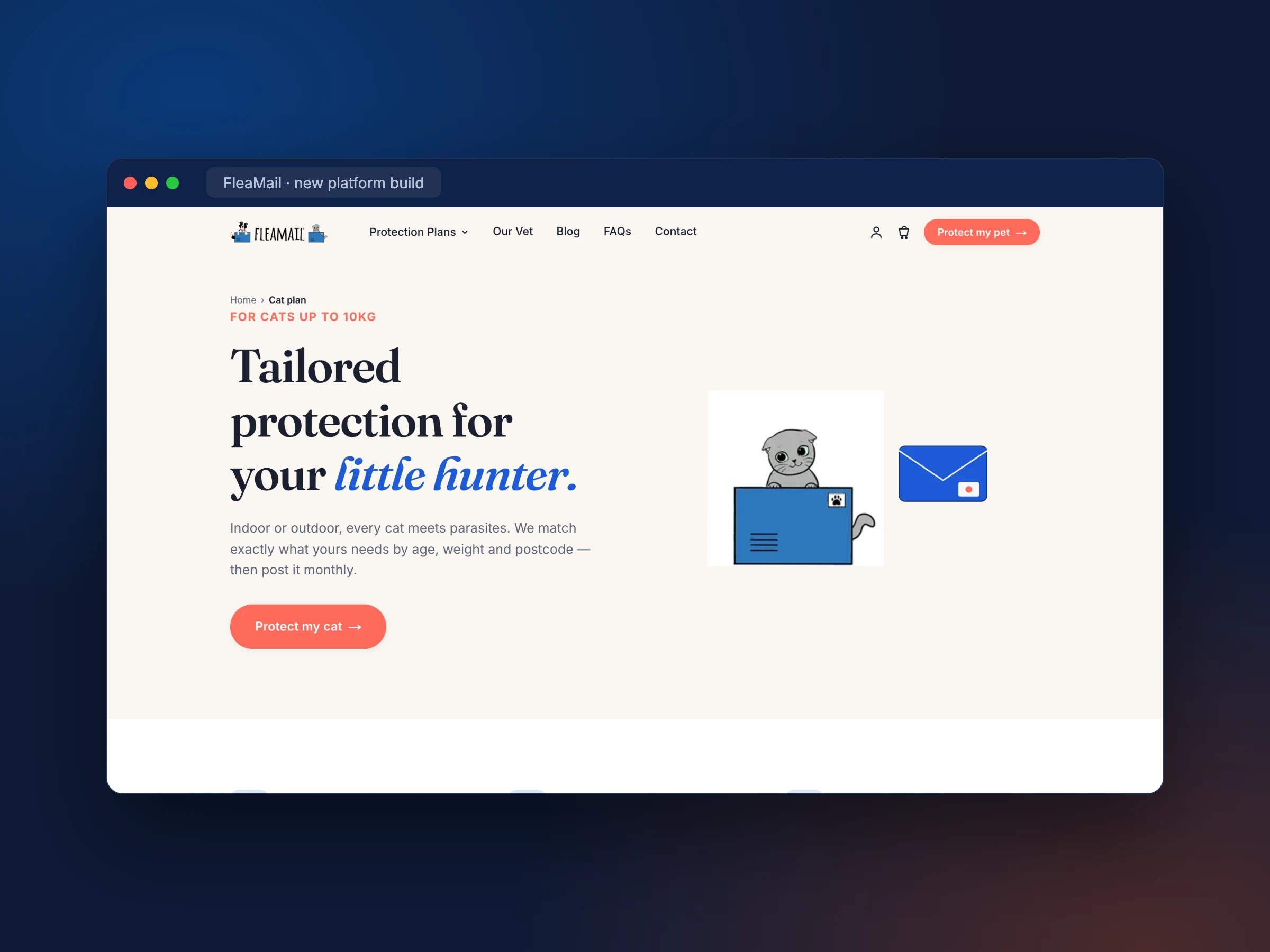
As an ecommerce development agency for Australia we are unusual in one way that matters: our Australian store is a subscription business, and subscriptions punish shortcuts. FleaMail sells vet-customised parasite treatment by the month. A customer picks a pet, enters a postcode and gets a plan; the postcode decides the parasite tier, because the risks in northern New South Wales are not the risks in Tasmania. After that, the store's real job is the renewal — the right product, the right price including the multi-pet discount, charged on the right day, and shipped in the envelope.
We rebuilt that from WooCommerce and WooCommerce Subscriptions into a custom Next.js platform. The checkout takes cards through Stripe Elements, so card numbers never touch the server, with PayPal alongside; both run on the client's existing merchant accounts so no customer re-enters a card. A fulfilment pipeline tracks each order from packing to delivery. Coupons, refunds and pauses are admin actions with an audit trail. The Google Merchant feed lists the plans with subscription pricing in Australian dollars, and purchase events go to Google Analytics and Meta from the server as well as the browser, so revenue is tracked even when a browser blocks the tag.
It is built and running in shadow mode against the live store; cutover follows a written runbook, and we will not describe it as launched until it is.
Custom, Shopify or WooCommerce
Most Australian stores should be on Shopify, and we would tell you so. Custom commerce is worth it when the product logic is the business — plans decided by postcode and weight, like FleaMail — or when the platform's fees and limits cost more than owning the code. WooCommerce makes sense where content is the traffic engine and the catalogue is modest. The teardown recommends one, with reasons, and it is often not the one that makes us the most money.
The Australian details
GST-inclusive pricing everywhere a consumer sees a price. Afterpay or Zip where your category expects it. Shipping rules built on Australia Post and courier zones rather than a flat rate that loses money on Perth. A returns policy that reflects consumer guarantees under Australian law, which you cannot contract out of. And a database hosted where you have decided it should be, not wherever the default happened to be.
How it runs
From teardown to renewals.
Store teardown
Free and written, inside 48 hours. Checkout, speed, tracking and the platform decision — including whether to stay where you are.
Scope and fixed price
Every page, integration and billing rule listed, priced in Australian dollars, approved before we start.
Build on staging
A staging store from week one, with test payments running through the real gateway configuration.
Migrate and hand over
Products, customers, orders and subscriptions moved and reconciled; redirects in place; every account in your name.
Money
How we quote.
Store build or rebuild
A written scope and one price in Australian dollars, covering the storefront, checkout, billing rules and migration.
- ✓Platform recommendation first
- ✓Migration and redirects included
- ✓Out-of-scope stated explicitly
Subscription and checkout work
For an existing store: recurring billing, plan logic, a better checkout, or tracking that finally matches revenue.
- ✓Fixed scope
- ✓Test payments on staging
- ✓Written handover
Monthly development
Ongoing changes to a store you own, billed monthly with no lock-in.
- ✓Cancel with notice
- ✓Staging for every change
- ✓Your accounts, always
No rate card, in any currency, and no comparison with local agency prices. One written scope and one price, agreed before anyone starts.
FAQ
Straight answers.
Built and run by us
Our own products, in production.
More from GOFTECH
Where to look next.
Shopify Agency in Islamabad
A Shopify agency in Islamabad with a real office on Main PWD Road. Store builds, rescues and cash-on-delivery order flows — come in person.
Web Development in Australia
A web development company Australia can check: an Islamabad studio with three Australian clients, a WordPress-to-Next.js re-platform, fixed…
Ecommerce Development for UK Retailers
An ecommerce development agency UK retailers can outgrow us with: 14 published stores across four platforms, including a British…