
Start with the disclosure, because everything below reads differently without it. We are an engineering studio in Islamabad. We have no office in either city, no British entity, and no intention of listing an address we do not occupy. You are reading an article by one of the options, so treat it as an argument to check rather than advice to take.
What follows is written to be useful even if you hire somebody down the road from you, which is a likely and often correct outcome.
Why there is no page on this site for either city
Because it would be a lie of omission, and a fairly transparent one.
The standard practice in this industry is a template: take the national service page, substitute the city name in the heading and the meta description, add a paragraph about the local business community, publish. Do it for six cities and you have six pages that rank for a while and tell a reader nothing. Search engines have a name for that pattern and it is not a compliment; more to the point, a buyer who clicks two of them notices immediately.
So the northern and midlands city terms live here, in an article that can be honest about the trade, rather than on two pages that would have nothing in them but a place name. If you want the actual service detail, the Shopify page carries it — including the part where we say we have not yet built a store for a British merchant. If you are weighing the capital specifically, that comparison is set out separately.
What a regional agency genuinely gives you
Three things, and they are real rather than sentimental.
The same working day, in the same room if you want it. This is the whole of the practical case and it is a strong one. Store work is often conversational — a merchandising decision, a look at something on a phone, a quick call about a supplier feed. When your developer is three streets away or three hours ahead, that conversation is free. When they are five hours ahead, it happens tomorrow morning.
Someone your team can escalate to. Some businesses need this because of who they answer to: a board, a procurement policy, an investor who wants a domestic supplier on paper. That is a legitimate requirement rather than a preference, and no contractual structure substitutes for it.
Sector knowledge that is genuinely local. A Manchester agency that has built four stores for northern fashion brands has met your delivery expectations, your returns rate and your peak season before. That is worth something concrete, and it is the strongest argument for hiring nearby — much stronger than proximity on its own.
And what it does not give you
Two things that get assumed and should not be.
Being nearby is not availability. A busy agency ten minutes away can be less responsive than a well-run remote one, and "we are local" is frequently doing the work that a service-level commitment should be doing. Ask for response times in writing from everybody, including the firm in your own postcode.
Being outside London is not automatically cheaper. The gap between capital rates and regional ones is real but narrower than people assume, and a good regional agency prices on the quality of its work rather than on its postcode. If your reason for looking north is purely budget, compare actual written quotes, because the saving may be smaller than the search implied.
Manchester and Birmingham are not interchangeable
Treating them as one market is the mistake this article's title risks encouraging, so it is worth separating them.
Manchester has the deeper commercial ecommerce concentration — a genuine cluster of consumer brands, and with it a larger pool of agencies who have shipped stores at volume. If you are a direct-to-consumer brand, you have a real choice of firms with directly relevant work there, and you should ask each of them for two clients in your sector you can telephone.
Birmingham's strength is different and less discussed: a broader base of manufacturing, trade and business-to-business operators, and agencies whose experience runs to catalogues, trade pricing and account-based ordering rather than fashion drops. If you sell to businesses rather than consumers, a Shopify agency Birmingham based may understand your ordering model considerably better than a consumer specialist in a bigger city would.
The general point matters more than the specific one. Sector fit beats city fit. A web development company Manchester businesses rate highly for fashion is not the right choice for a trade supplier with tiered pricing, and the reverse is equally true.
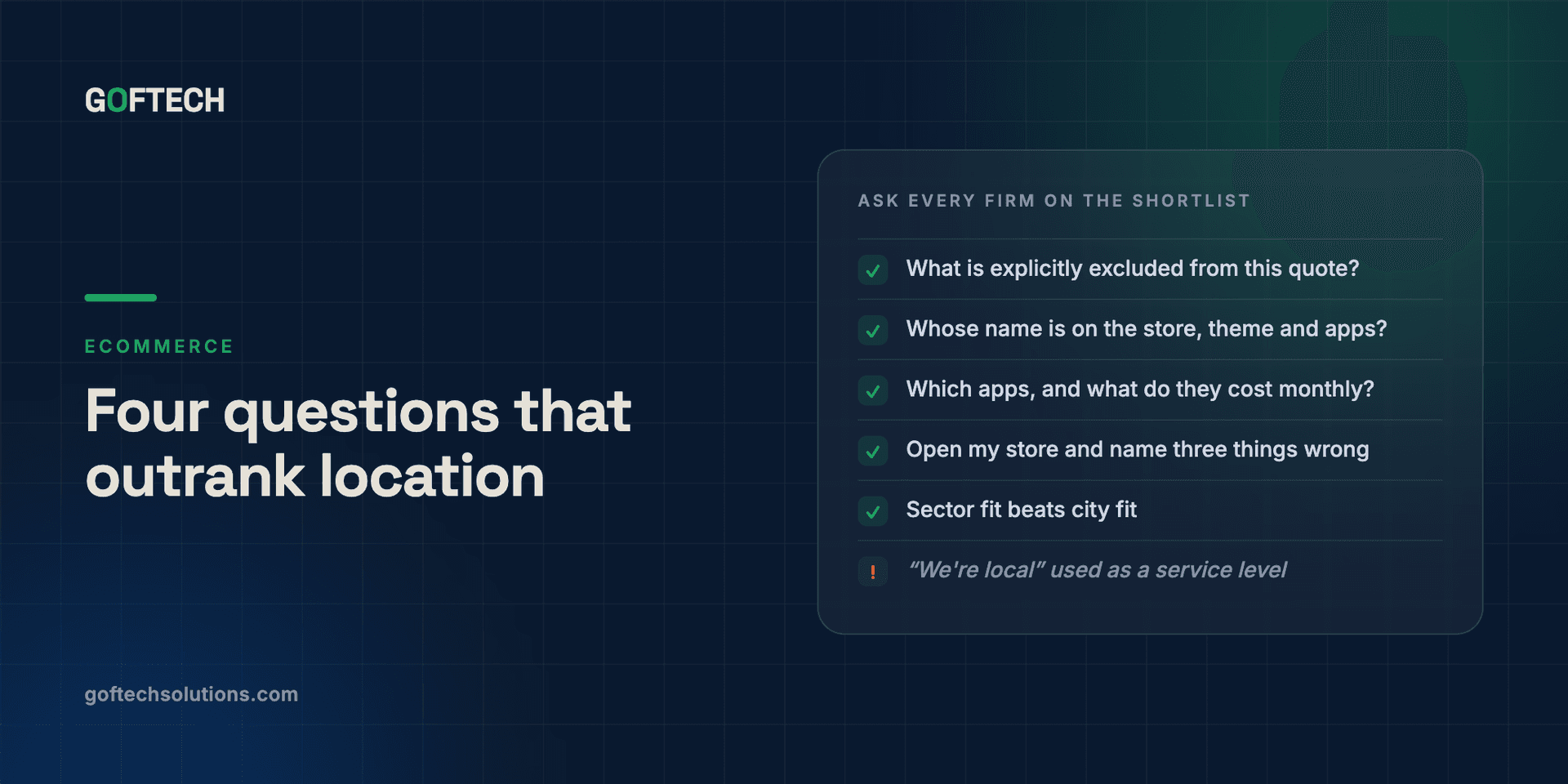
The four questions that outrank location
Ask these of every firm on your shortlist, wherever they are. In our experience they predict the outcome far better than distance does.
1. "What is explicitly excluded from this quote?" A proposal without an exclusions section is an opening position rather than a price. The cheapest quote usually has the longest exclusions list, and reading it is the whole comparison. Content, migration, the redirect map and post-launch support are where the differences hide.
2. "Whose name is on the store, the theme and the apps?" The answer should be yours, from day one. Your Shopify account should be registered by you with the agency granted staff access, and the theme should be yours outright rather than licensed. Agencies that build inside their own partner account and transfer later are creating a dependency you did not agree to.
3. "Which apps will this install, and what do they cost every month?" Apps are how a cheap build stays cheap — functionality that belongs in the theme gets solved with a subscription instead. Four of those become a real recurring bill and four more script tags slowing your storefront. Get the list, with monthly costs, before you compare any two quotes.
4. "Open my store on your phone and tell me three things wrong with it." This is the most useful question in the whole process and it costs nothing. An agency that comes back naming specific apps, specific images and a specific step in your checkout has actually looked. One that comes back proposing a discovery workshop has not. It works on us too, and you should use it on us.
When we would tell you to hire locally
Three situations, and we mean them, because a project taken on the wrong terms damages us more than the invoice is worth.
If the work is continuous and conversational rather than a defined project, hire nearby — a half-day overlap is workable for a build and genuinely worse for a relationship where decisions get made in passing. If your governance or procurement requires a domestic supplier, that settles it and there is nothing to discuss. And if the job is a few days of theme work, the coordination overhead across time zones costs more than the rate difference saves; find a good freelancer in your city.
Where the offshore answer competes properly is on a defined piece of work with a written scope — a build, a replatform, a catalogue restructure, a speed rescue — where the same budget buys materially more engineering time. That is the entire argument, and there is nothing clever about it.
A fair way to test any of us
In the end, choosing a Shopify agency in Manchester or Birmingham comes down to the same evidence as choosing one anywhere else, and there is a cheap way to gather it. Ask three firms for a free written read of your existing store before you ask any of them for a quote. Compare the documents rather than the proposals. The one that names specific problems on specific pages has done the work; the one that returns a generic audit score has run a tool.
That is what we offer and it is deliberately portable — the teardown comes back inside 48 hours, it names what is slowing your store down, and you are welcome to hand it to an agency in your own city and ask them to quote against it. We would rather your store got fixed than that we won an enquiry we were the wrong choice for.


