Read this before you commission
The first version should be embarrassing, and it should exist.
Most failed products here did not fail at the engineering. They failed because eleven months of building happened before anybody outside the founding team used the thing.
The scope that grows while you build
The single most common pattern: a product specified at forty screens, launched at ninety, eighteen months late, and the forty would have answered the question. Every feature added before the first real user is a bet placed with no information. We will push back on scope — sometimes hard — and the push-back is the service. An MVP development company UK founders should hire is one that argues you out of features, not one that quotes them cheerfully.
The demo that cannot become the product
The opposite failure, and it costs more. Something is assembled quickly to show investors, it works, and then it turns out there is no tenancy model, no permission system and no way to have two customers without them seeing each other's data. Retrofitting that is close to a rewrite. There is a middle path — conventional architecture, tenancy in from day one, features ruthlessly cut — and it is the one worth paying for.
Nobody scoped the boring half
A product is not the feature you pitched. It is that feature plus sign-up, password reset, roles, invitations, an admin view for your support person, an audit trail for when a customer disputes something, and a billing integration that handles a failed card. That list is most of the work, it is the same list for nearly every product, and a quote that does not mention it is a quote for the demo.
What we have shipped, and what we have not
This is the page on this site where the gap between the search term and the published evidence is widest, so it is stated rather than glossed.
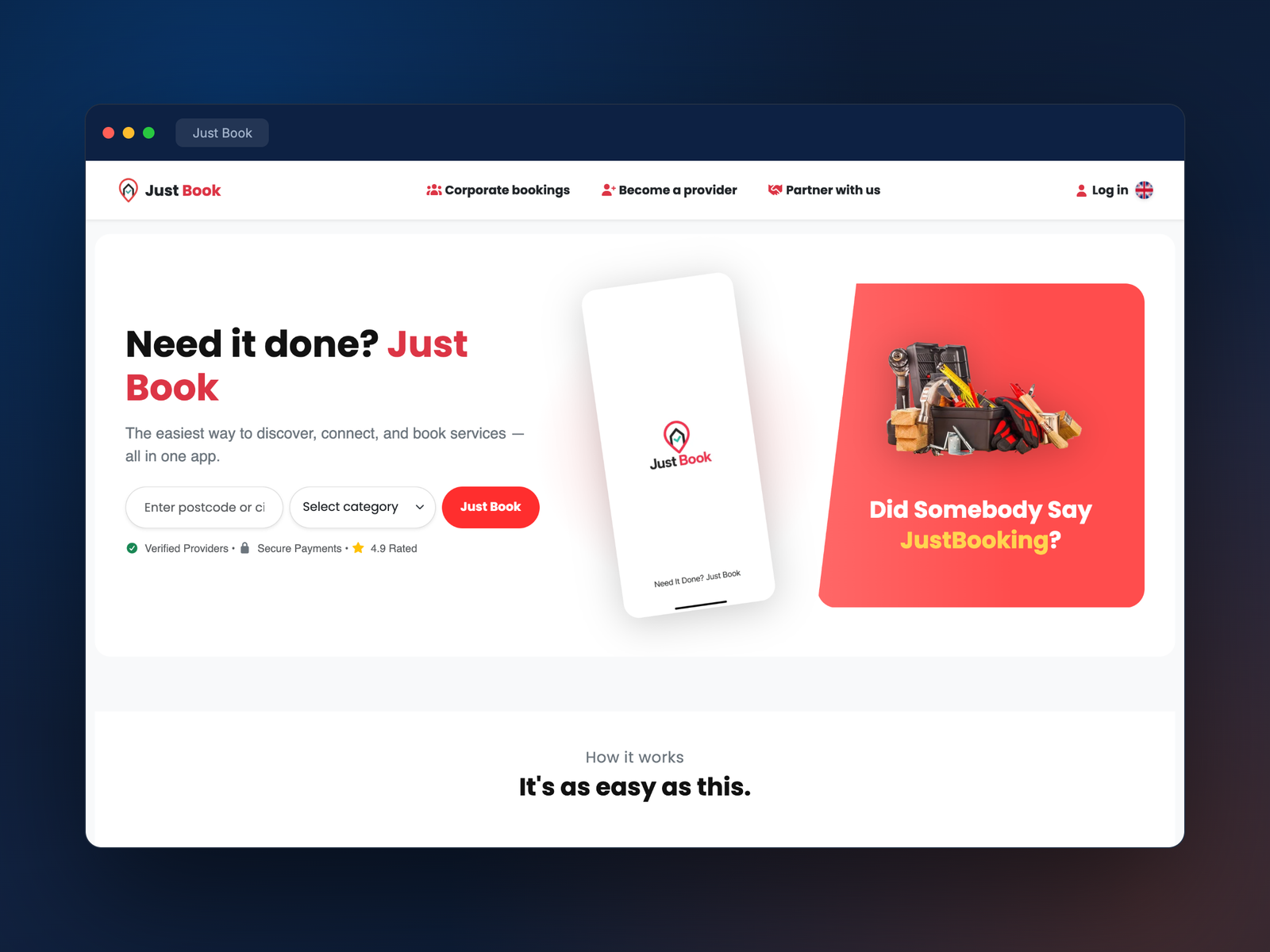
What is published and checkable: Just Book, a two-sided marketplace built over five months — a Flutter app on both stores, a Laravel web platform, shared APIs, verified provider profiles, in-app chat with quotes attached, secure payment, a six-stage booking tracker, and a provider and admin back office. That is platform engineering: multiple user types, permissions, an operational back end and one API that three surfaces depend on. Alongside it, several custom systems with roles and admin tooling, and one subscription business.
What is not: if you are shortlisting a SaaS development company UK-side or offshore on published products alone, this is where we come up short — we have not published a live multi-tenant product with recurring billing for a British client. The SaaS-shaped work in our library is real but currently unpublished, so it is not offered here as proof. If a subscription product with tenancy and dunning is exactly your project, ask on the call and we will show you what exists rather than pointing at this page.
Why that distinction matters more than it sounds
Plenty of agencies answer this query with a portfolio of dashboards. A dashboard is not a product: the hard parts of SaaS are tenancy, permissions, billing edge cases and the operational tooling your support team needs at two in the afternoon on a Tuesday. Choosing a SaaS development company in the UK market, or an offshore one, should turn on whether they talk about those things unprompted. If the conversation is entirely about screens, you are buying a demo.
Where we are
Islamabad. No UK entity, no UK office. For product work the time-zone gap is mostly an advantage — you review in your morning, we build while you are elsewhere, and there is a new version each day — but live support for paying customers is a different arrangement and one to agree in writing rather than assume.
Delivered
Platform work, with the back offices behind it.


Related
Where a product project usually starts.
If it is really a bespoke system
Internal platforms and operational software for one organisation, rather than a product sold to many.
If it needs to be on a phone
The app side, including the honest question of whether your product needs an app at all in year one.
The market page
How working with an Islamabad studio actually runs — overlap, contracting, payments and what we will not claim.
How it runs
Smallest useful thing first.
Teardown
Free, written, inside 48 hours — including which features we think you should cut from version one, and why.
Scope and fixed price
The cut-down version, priced. Every screen, the boring half included, and what is explicitly deferred.
Build in the open
A staging URL from week one that you and a handful of real users can log into long before launch.
Launch and hand over
Repository, hosting, every account in your name — and documentation aimed at the engineer you have not hired yet.
Money
How we quote a product.
Version one, fixed scope
The deliberately small first release. One written scope, one price in pounds, and a list of what we have argued out of it and why.
- ✓Tenancy and roles from day one
- ✓The boring half included
- ✓Deferred list written down
Build then iterate
Version one fixed-scope, then a monthly arrangement once real users are in it and you are deciding from evidence rather than guesses.
- ✓Monthly, cancellable
- ✓Reprioritised from usage
- ✓Stop whenever you like
Rescue a stalled product
A build that has run long, a demo that cannot scale, or a codebase whose author has gone. Quoted after we read it.
- ✓Written assessment first
- ✓Continue-or-rebuild answer
- ✓Full credential handover
No figures appear on this site in any currency. Product quotes vary more than any other category on it, because the difference between forty screens and ninety is the whole price. The teardown is free and gives you a real number for the version we think you should build.
FAQ
Straight answers.
Built and run by us
Our own products, in production.
More from GOFTECH
Where to look next.
SaaS and Web App Development for US Founders
A SaaS development company USA founders can hand to their own engineers: multi-tenant systems with roles, permissions and a real admin side.
SaaS Development in Pakistan
A SaaS development company in Pakistan building multi-tenant products: accounts, roles, subscriptions and the admin behind them. Repository…
Shopify for London Merchants
Choosing a Shopify agency London based or offshore: the honest comparison, including when hiring in the capital is right. We are in…