
You have come here for a number and this article does not have one. That is worth explaining rather than burying, because the explanation is most of the useful content.
Every published figure for this question is one of two things. It is either a range so wide it contains every project anyone has ever built — which tells you nothing you did not already know — or it is a specific number that is wrong for your project, priced to cover the most complicated version of it so the agency is never caught short. Both are marketing. What follows is the thing a number would be standing in for: what actually moves the price, how to read the quotes you are about to receive, and what the cheapest one is quietly leaving out.
Why the honest answer is a range you cannot use
Shopify projects are not one product. The same three words cover a merchant who wants a well-chosen theme configured properly and launched in a fortnight, and a merchant who needs a bespoke wholesale ordering flow, a bidirectional sync to their warehouse system and a checkout extension. Those two are not the same job at different sizes. They are different jobs.
An agency that publishes a single figure has to pick one of them to price for. If they price the first, the second arrives as a change request and the relationship starts with an argument. If they price the second, most of the people reading the page leave. So the figure gets set high enough to be safe and vague enough to be defensible, and everybody's time is wasted politely.
What is genuinely useful is knowing which of those two jobs you are commissioning — and that you can work out yourself in about twenty minutes.
The five things that actually move the price
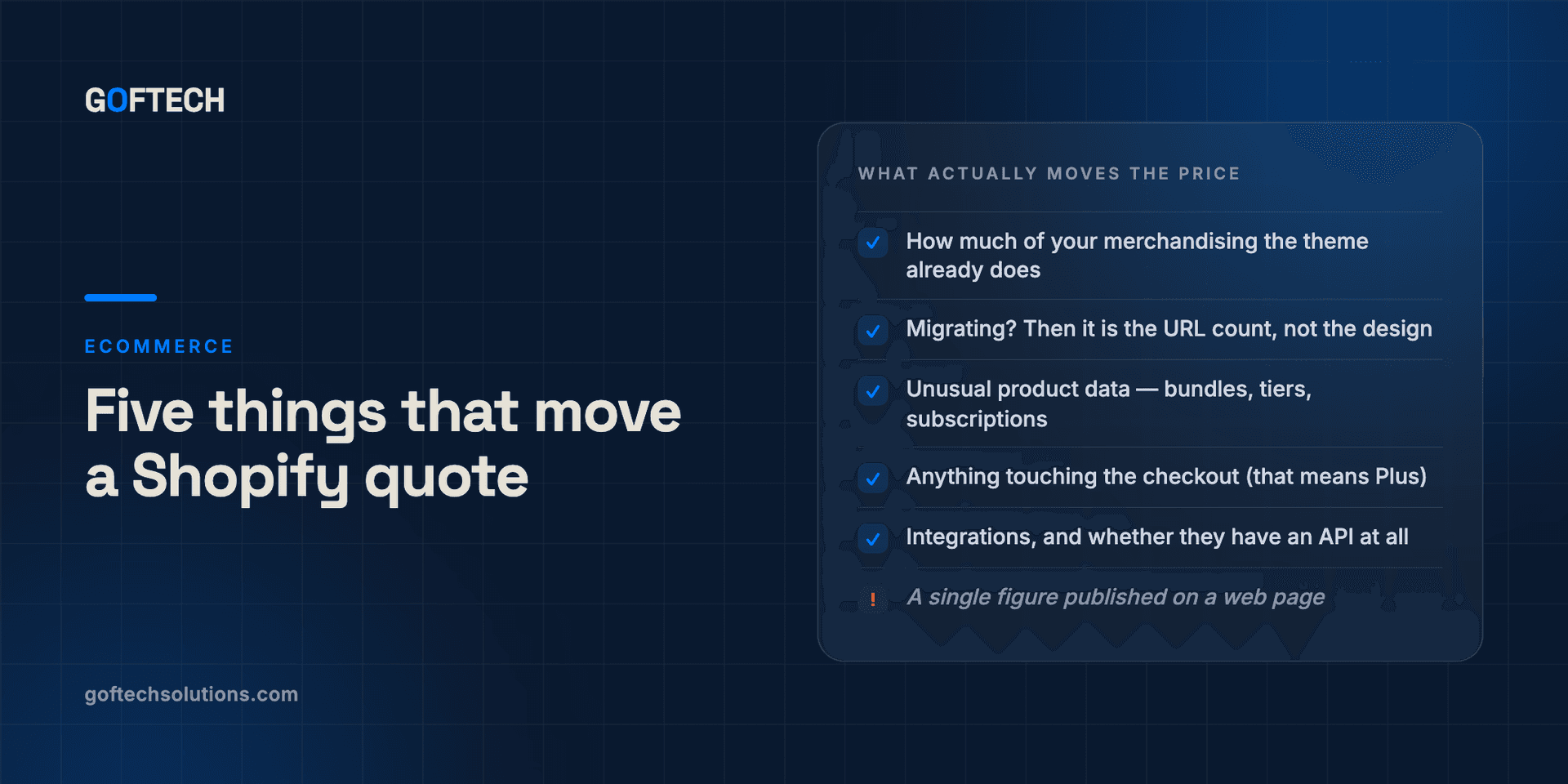
In rough order of impact. If you can answer these five before you speak to anybody, you will get quotes that are comparable, which is more valuable than getting them low.
1. How much of your merchandising the theme already does. This is the single biggest variable and almost nobody asks about it. A good commercial theme handles a conventional catalogue — products, collections, variants, a cart — without any custom work at all. Cost enters when your merchandising does something the theme has no concept of: a size guide that varies by brand, a room-based browse alongside a category-based one, bundles that are priced differently from their parts, a made-to-order product with configuration steps. Each of those is a custom section, and custom sections are the bulk of a build invoice.
2. Whether you are migrating, and how many URLs you have. A new store starting from nothing is a smaller job than a replatform, and the difference is not the design. It is the catalogue reconciliation and the redirect map. A shop with four hundred products and a decade of blog posts has thousands of addresses that must each be mapped to a new one, and doing that properly takes real time. Doing it improperly costs you the search traffic you spent years accumulating, which is the most expensive way this project can go wrong.
3. How unusual your product data is. Simple products with a couple of variants are cheap to move and cheap to build for. What costs money: products with more option combinations than the platform natively supports, subscriptions, tiered or customer-specific pricing, bundles, and anything where the price is calculated rather than set. Every one of those is knowable from an export of your catalogue before anybody quotes.
4. Whether you need the checkout changed. On standard Shopify plans, you cannot meaningfully alter the checkout — and anyone telling you otherwise is describing something that will break at the next platform update. Checkout customisation requires Shopify Plus, which is a different commercial conversation entirely. If a requirement in your brief touches the checkout, establish that early, because it determines which plan you are on and therefore a recurring cost that dwarfs the build.
5. How many integrations, and whether they have APIs. Connecting to a well-documented accounting package or a mainstream courier is routine. Connecting to a warehouse system written in 2004 with no API and a nightly CSV export is a project of its own. Agencies quote the first from experience and discover the second in week six. Name every system your store must talk to in the brief, including the one in the back office everybody has stopped mentioning because it is embarrassing.
How to read three quotes that disagree wildly
You will get three numbers with large gaps between them, and the instinct is to assume the middle one is honest. It usually is not — usually the gaps mean the three agencies scoped three different projects. Four checks turn incomparable quotes into comparable ones.
Find the exclusions section. A quote without one is not a quote, it is an opening position. The exclusions are where you learn that content migration, product photography, copywriting, the redirect map or post-launch support are somebody else's problem. The cheapest quote very often has the longest list of things it does not contain, and reading that list is the entire comparison.
Count the custom sections. Ask each agency to list, by name, the parts of the site that are not stock theme functionality. If one says three and another says eleven for the same brief, one of them has misunderstood your merchandising — and it is worth finding out which before you choose, not after.
Ask what apps are in the plan, and what they cost monthly. Apps are how a cheap build stays cheap: functionality that could be built into the theme gets solved by installing something with a subscription. Three or four of those quietly become a meaningful recurring bill, and each one injects script into your storefront. A build quote is not comparable to another until both are stated with their app subscriptions attached.
Ask who owns what at the end. The theme, the store admin, the domain, the apps, and any custom code. The answer should be that all of it is yours and always was, since your Shopify account is registered by you. Where this gets murky is agencies that build in their own partner account and transfer later, or that treat a custom theme as their intellectual property licensed to you. Both are worth knowing about at quote stage.
The costs that are not in anybody's proposal
Three of these catch out almost every first-time merchant, and none of them is hidden — they are simply not part of what an agency is quoting for, so nobody mentions them.
The platform itself. Shopify is a monthly subscription plus a transaction cost, and the plan you need is determined by your requirements rather than by your preference. If your brief needs checkout changes or advanced B2B rules, that is a much larger plan. Establish this before you compare build quotes, because it can outweigh the differences between them.
Content. Product photography, descriptions for a catalogue of any size, and the copy for every page that is not a product. Agencies assume you are supplying it; merchants assume it is included. It is the most common cause of a launch date slipping, and it slips by weeks rather than days.
Whatever happens after launch. Themes need updating, apps break each other, platform features change, and something will need adjusting in month three whatever anybody promises. This is either a support arrangement you pay for or somebody on your team learning to do it. It is not nothing, and a proposal that never raises it has either not thought about year two or is hoping you will not.
Where the UK part actually matters
Less than you might expect, and it is worth being precise, because "UK-specific" is often used to justify a premium for configuration.
The engineering is identical to anywhere else — Shopify is the same platform in Leeds as in Los Angeles. What is genuinely local is a short list: prices displayed inclusive of VAT, the delivery options British shoppers expect including click-and-collect, a returns window stated where people actually look for it, and payment methods that feel familiar rather than foreign. All four are configuration and content decisions. They matter enormously to conversion and they are not expensive. Any agency describing them as a specialist workstream is padding.
What does legitimately affect the price is where the people doing the work are. Rates in London are not rates in Manchester and neither is a rate offshore, and that is a real difference rather than a quality signal in either direction. What you should compare is scope for the money and what happens when something breaks, not the hourly figure.
How to get an actual number
Everything above is aimed at one outcome: arriving at a quote conversation with your project defined well enough that three agencies price the same thing. Do that and the numbers become informative. Skip it and you are comparing three guesses about what you meant.
Write down your answers to the five variables. Export your catalogue. Crawl your existing site or ask someone to, so you know the URL count. List every system the store must talk to. Then ask each agency for a written scope with an exclusions section, a named list of custom sections, and the app subscriptions attached.
For what it is worth, that is how we do it here: a free written teardown inside 48 hours that reads your existing store and tells you what would move the price, followed by a fixed scope and one figure that only changes if you change what you asked for. You are welcome to take the teardown and give it to somebody else — it names specific problems on your specific store, which makes it useful whoever ends up doing the work. If you want to see how we approach store builds, the Shopify page sets out what we do and, more usefully, what we have not done yet. If you are weighing a local agency against an offshore one, that comparison is written out honestly here, including the situations where hiring in the capital is the right answer.


