The Role of Marketing Funnels in Lead Generation Success
Think of a digital marketing funnel as a roadmap for a relationship. You don’t ask someone to marry you on a first date, and you shouldn’t ask a complete stranger to buy your most expensive product the second they hear about your brand.
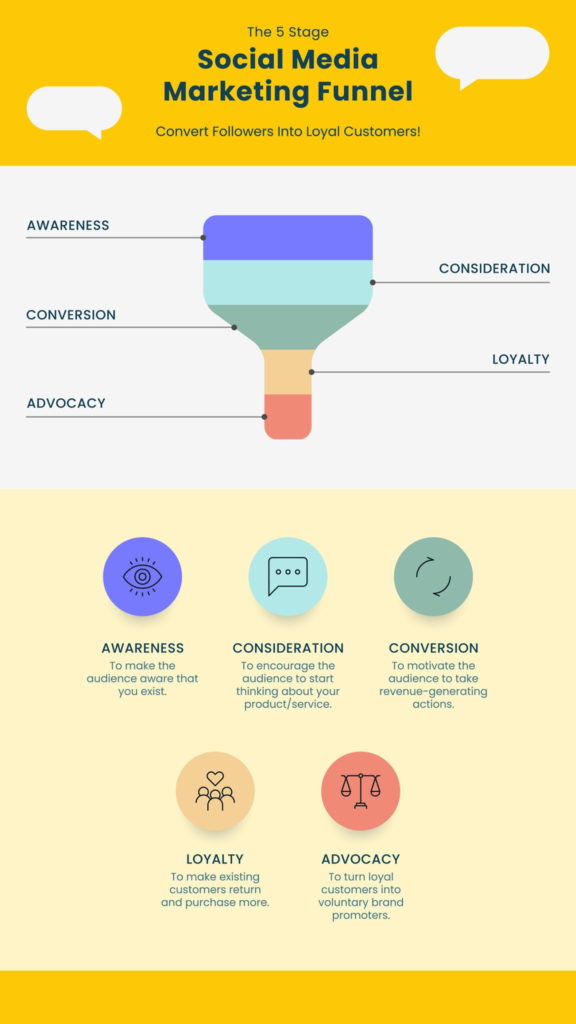
A marketing funnel service is a structured framework that visualizes the entire journey your customer, from the exact moment they discover your business to the moment they make a purchase (and ideally, become a loyal fan). It is called a funnel because it starts wide—attracting a massive audience—and naturally narrows down as people drop off, leaving you with highly qualified buyers at the bottom.
Anatomy of a Funnel: The Core Stages
To build a high-converting system, you need to understand how consumers think as they move through the three primary phases of the classic marketing funnel.
1. Top of the Funnel (TOFU) – Awareness & Discovery
- The Goal: Get noticed and spark interest.
- The User Mindset: “I have a problem, and I’m looking for information.”
- Content Strategy: Educational blog posts, social media content, and high-level videos. At this stage, you are not selling your product; you are selling your expertise and showing that you understand their pain points.
2. Middle of the Funnel (MOFU) – Consideration & Evaluation
- The Goal: Nurture the relationship and capture contact information (Lead Generation).
- The User Mindset: “I know my options. Why should I choose you over a competitor?”
- Content Strategy: Free ebooks, webinars, templates, and case studies. This is where you exchange high-value resources for their email address or phone number, transforming anonymous visitors into identifiable leads.
3. Bottom of the Funnel (BOFU) – Conversion & Action
- The Goal: Close the deal.
- The User Mindset: “I’m ready to buy. I just need to make sure this is worth my money.”
- Content Strategy: Free trials, live demos, discount codes, and bold client testimonials. You are removing the final friction points to make the purchase decision a no-brainer.
Building the Engine: Ads, Landing Pages, and Video
A theoretical funnel is useless without the technical assets that drive traffic through it. The modern high-growth funnel relies on three major pillars working in tandem:
Ads + Funnel Integration
Paid advertising (like Meta, Google, or TikTok Ads) acts as the fuel for your funnel. Instead of running ads that scream “Buy Now!” to strangers, align your ad campaigns with your funnel stages:
- Prospecting Ads: Target broad interests with engaging, educational content to build Awareness.
- Retargeting Ads: Show specific lead magnets or product benefits strictly to people who visited your site but didn’t convert, pulling them into Consideration.
The Importance of Dedicated Landing Pages
Sending ad traffic to your website’s generic homepage is a conversion killer. Homepages offer too many distractions (About pages, blog links, multiple tabs).
A Landing Page is a hyper-focused webpage designed with a single goal in mind: getting the user to take one specific action (like downloading an ebook or buying a product). By eliminating navigation links and focusing 100% on a single Call-to-Action (CTA), landing pages drastically increase your conversion rates.
The Power of Video-Based Funnels
Video is the ultimate shortcut to building trust. A video-based funnel uses short-form videos (Reels, TikToks, Shorts) at the Top of the Funnel to grab fast attention, mid-form videos (YouTube videos, explainers) in the Middle of the Funnel to educate, and long-form video (Webinars, VSLs—Video Sales Letters) at the Bottom of the Funnel to break down objections and close sales.
The Step-by-Step Sequence to Launch and Optimize Your Funnel
Building a funnel requires a logical, sequential setup. If you run ads before your landing page is optimized, you are simply throwing money away. Use this structural sequence to launch correctly.
1.Define Your Lead Generation Strategy: Step 1: The Incentive.
Determine your Lead Magnet—the high-value asset you will give away for free in exchange for contact information. This could be a cheat sheet, a free mini-course, or a custom calculator. It must solve a specific problem quickly.
2.Build and Structure the Landing Page: Step 2: The Destination.
Design a clean, fast-loading landing page. Ensure it features a compelling headline, a clear list of benefits, social proof (reviews/logos), and a highly visible, single-field opt-in form.
3.Set Up Tracking and Analytics: Step 3: The Infrastructure.
Install your ad tracking pixels (like the Meta Pixel or Google Analytics) before launching. You must be able to track exactly how many people click your ads, visit your page, and successfully submit their information.
4.Launch Integrated Ad Campaigns: Step 4: The Traffic.
Deploy your paid ads targeted at your ideal audience. Use engaging video elements or clean graphics to grab attention in the feed, directing all traffic straight to your new landing page.
5.Execute Conversion Rate Optimization (CRO): Step 5: The Iteration.
Once data rolls in, look for bottlenecks. If ad clicks are high but page sign-ups are low, rewrite your headline. If sign-ups are high but sales are low, improve your email follow-up sequence. Constantly test variables (A/B testing) to maximize return on investment.